
Why deciding when to stop trading can matter as much as deciding when to enter.
Most traders have rules for individual positions.
They know approximately where they want to enter. They identify stop losses and profit targets. Some calculate position size down to the last dollar.
But ask them a different question:
At what point do you stop trading for the day?
The answer is often surprisingly vague.
"I'll stop if things get bad."
"I'll take a break after a few losses."
"I'll see how the market behaves."
The problem is that these decisions are being left until the exact moment when emotions are most likely to influence them.
A better approach is to decide in advance when trading should temporarily stop.
Think of it as a circuit breaker for the account.
Why Individual Stop Losses Aren't Enough
A stop loss controls risk on a particular position.
It doesn't necessarily control the damage caused by a sequence of positions.
Imagine a trader starting the day with a $5,000 account.
Each position carries a planned risk of $50.
The first trade loses.
So does the second.
The third setup looks promising, but it fails as well.
By lunchtime, the trader has lost $150.
That's 3% of the account before execution costs.
Each trade may have respected its individual stop.
The problem is the cumulative exposure.
And after several unsuccessful trades, the trader may become more vulnerable to frustration, impatience and the desire to recover losses quickly.
The account needs protection at a level above the individual trade.
A Daily Loss Limit Changes the Conversation
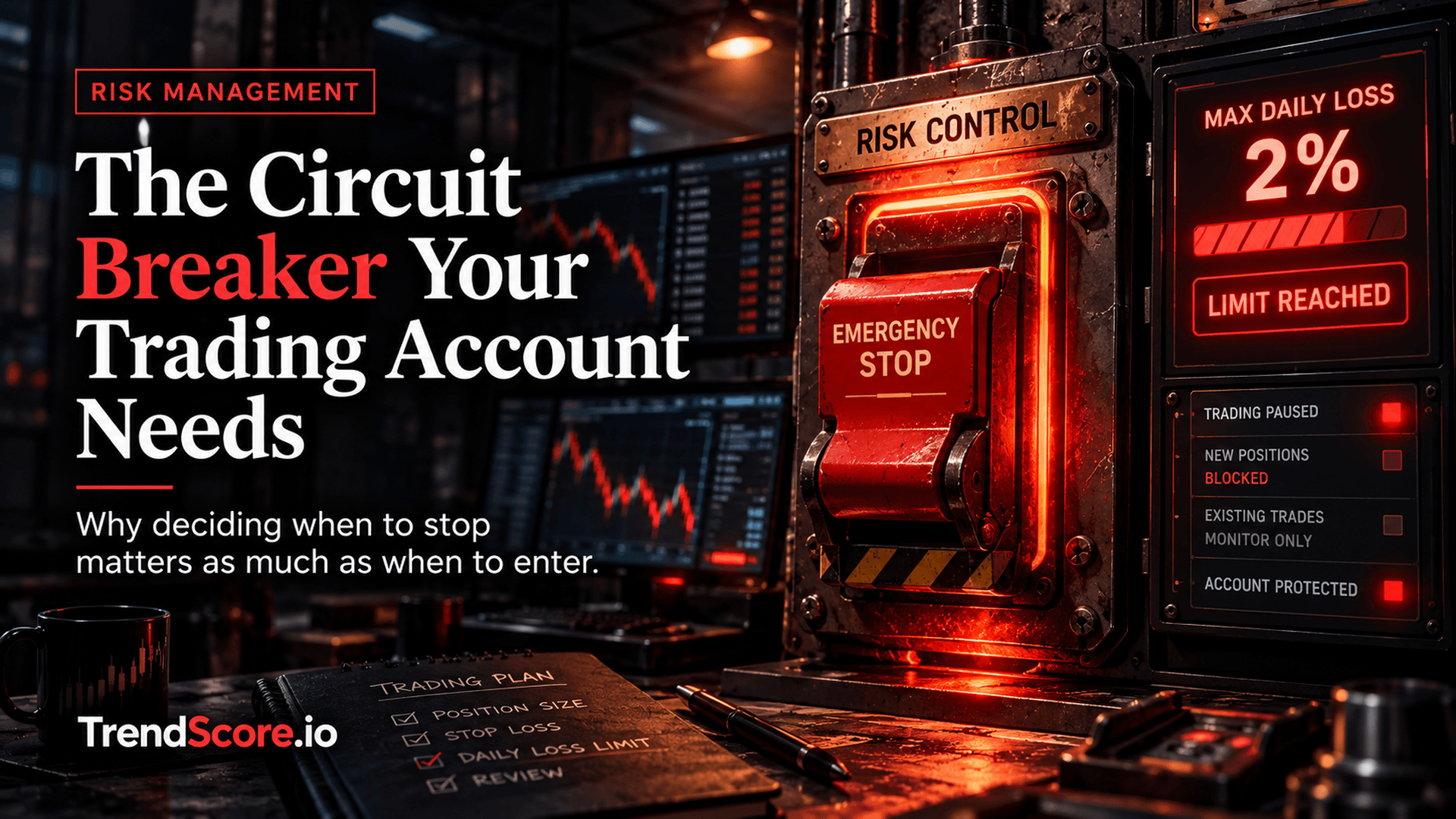
Suppose the same trader establishes an illustrative daily loss limit of 2% of starting equity.
With a $5,000 account, that's $100.
After two full $50 planned losses, the trader has reached the limit.
No additional discretionary positions are opened that day.
The market could produce an exceptional opportunity five minutes later.
The rule still applies.
That may sound unnecessarily restrictive.
But the objective isn't to capture every opportunity. It's to prevent an unfavourable session from developing into a much larger drawdown.
A daily loss limit can protect against two different problems.
The first is financial: repeated unsuccessful trades accumulate losses.
The second is behavioural: decision quality may deteriorate after prolonged frustration or fatigue.
Neither problem requires a trader to be unusually inexperienced.
They are ordinary risks associated with repeated decision-making under uncertainty.
The Limit Must Reflect the Actual Strategy
A circuit breaker shouldn't be selected randomly.
Consider a strategy that routinely experiences three or four consecutive losses before recovering.
A daily limit equivalent to one ordinary stop loss might interrupt the strategy constantly.
Conversely, a daily limit large enough to tolerate ten consecutive full-risk losses may do little to protect the account.
The appropriate threshold depends on the method's expected trade frequency, normal variability, historical losing sequences and maximum acceptable drawdown.
A sensible research process would examine how different account-level limits affect both losses and missed opportunities.
The objective is not to choose the smallest possible limit.
It's to establish a restriction that fits the strategy's risk characteristics.
Realized Losses Aren't the Only Exposure
An important technical detail is what counts toward the daily limit.
Suppose a trader has lost $70 on completed positions and has another open trade showing an unrealized loss of $60.
If the rule only considers realized losses, the trader may appear to remain below a $100 daily limit.
But the account is already experiencing a combined $130 decline relative to the day's starting reference.
This is why equity-based limits can be more informative than rules based exclusively on closed trades.
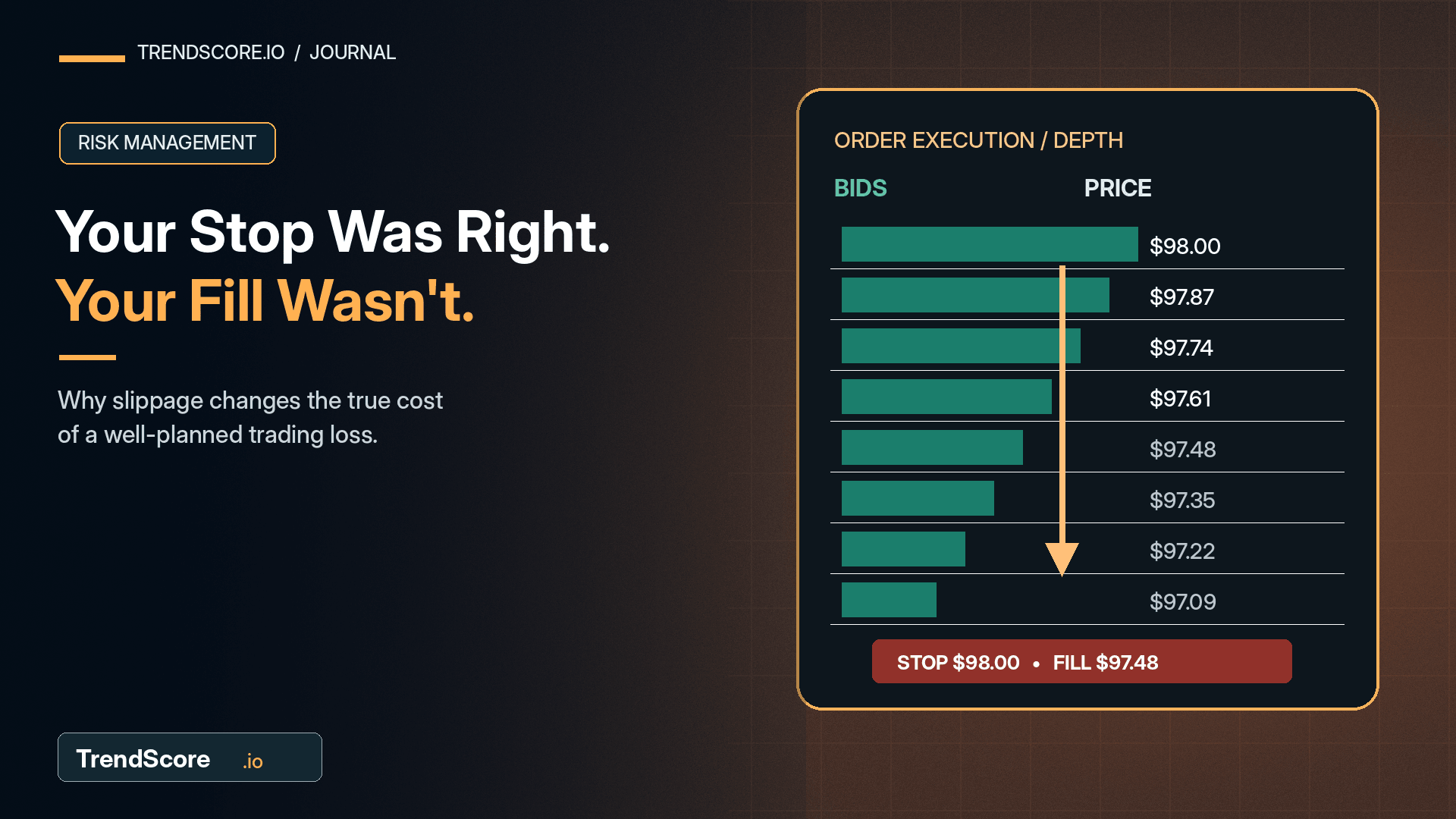
The framework should also consider open-order exposure, fees, funding costs and potential slippage.
A planned daily loss limit is a control mechanism, not an absolute guarantee that real losses cannot exceed it.
Rapid market movements can cause execution beyond intended thresholds.
What Happens When the Circuit Breaker Activates?
This should be decided before trading begins.
For example, a rule might prevent new discretionary entries for the remainder of the day.
Existing positions could be managed under their original risk plans rather than automatically liquidated, unless the framework explicitly requires otherwise.
A different strategy may require reducing exposure when total account risk reaches a specified threshold.
The critical point is clarity.
A rule that can be reinterpreted during a losing session is not much of a rule.
If exceptions are allowed, they should be defined in advance rather than invented under pressure.
The Weekly Limit Matters Too
A trader might never reach a daily loss threshold but still lose money consistently across several sessions.
Five days of moderate losses can create a substantial weekly drawdown.
This is why some traders establish more than one level of protection.
A daily limit controls the immediate session.
A weekly limit may trigger a longer review period.
A larger account drawdown threshold may require reduced position sizing or a formal strategy evaluation.
These controls shouldn't be introduced merely because they sound professional.
They need to be tested for their effect on the overall methodology.
But thinking about cumulative losses is essential.
Risk doesn't reset simply because the calendar changes.
A Circuit Breaker Isn't a Cure for a Bad Strategy
There's an important limitation.
Stopping after several losses doesn't transform a strategy with negative expected value into a profitable one.
A trading system that consistently loses after costs requires investigation into its underlying methodology.
Account-level limits may reduce the severity of some losing periods, but they can also prevent participation in subsequent successful opportunities.
Their usefulness must be evaluated with realistic historical testing and forward observation.
A circuit breaker is a risk-control measure, not a source of trading edge by itself.
Protect the Decision-Making Process
One of the greatest benefits of predefined limits is that they remove a difficult decision from an emotionally charged moment.
Instead of asking whether to keep trading after several frustrating losses, the trader follows a condition established earlier.
The market may still offer opportunities.
But the account has reached a level of exposure that the trader previously agreed was sufficient.
TrendScore's structured scenarios help organize trade-level risk. An account-level circuit breaker adds another layer that individual entries, stops and targets cannot provide on their own.
The most important trading decision on some days isn't which position to open next. It's recognizing that you've already taken enough risk for one session.