
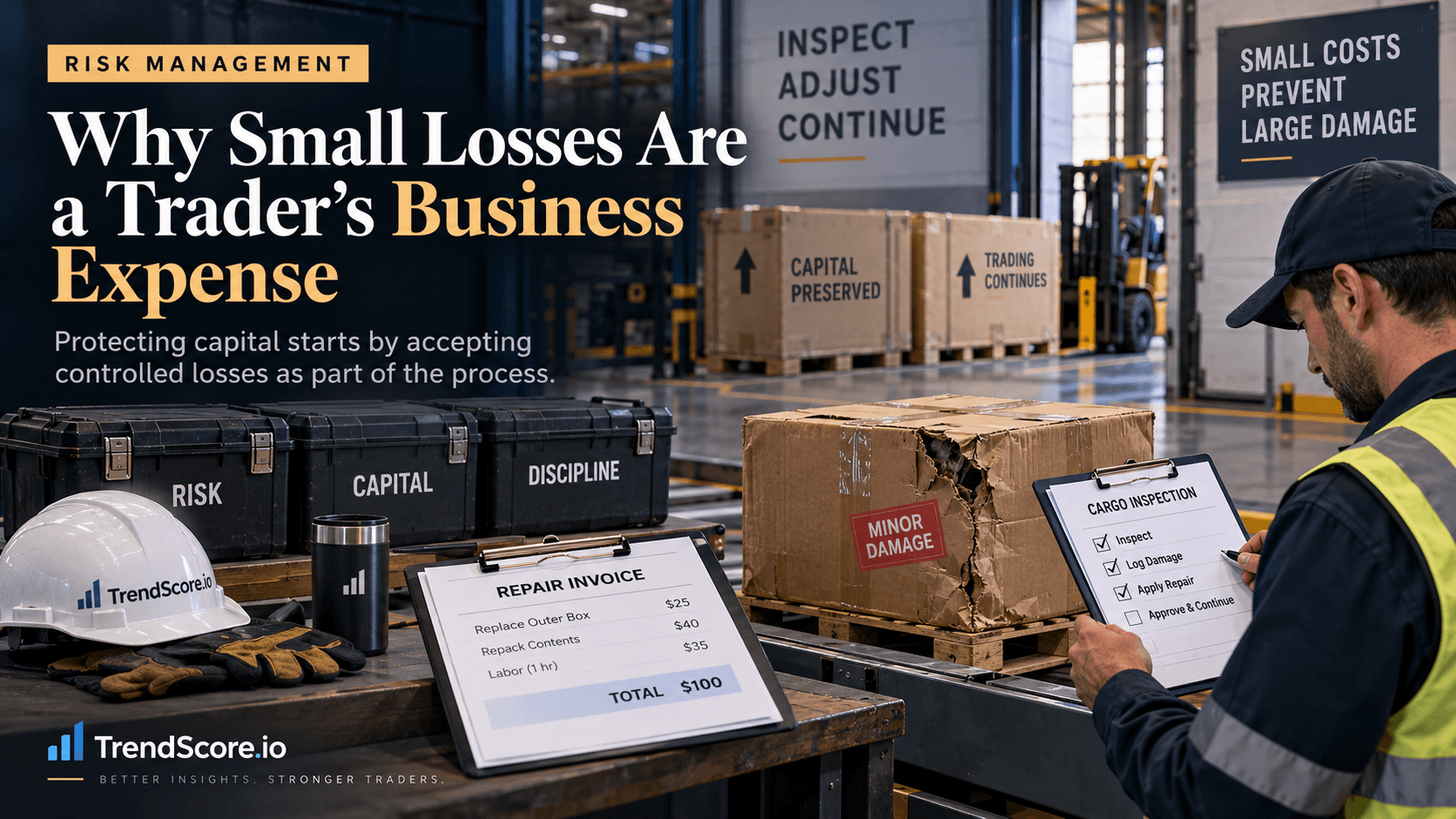
The difference between a controlled trading loss and a costly failure of discipline.
A restaurant owner doesn't expect every table to be profitable. A manufacturer doesn't expect every production run to be flawless. Even a well-managed company has maintenance costs, damaged stock and expenses that are simply part of operating.
Yet many traders approach financial markets with an expectation they would never apply to an ordinary business.
They expect every decision to work.
When it doesn't, they feel compelled to repair the result immediately.
That's where a routine trading loss can become something much more expensive.
Not Every Losing Trade Is a Mistake
Consider two traders who each lose $50.
The first entered according to a tested strategy, respected the planned position size and exited when the original market conditions were invalidated.
The second entered impulsively, moved the stop several times and finally closed the position only because the emotional pressure became unbearable.
Both lost the same amount of money.
But the quality of their decisions was entirely different.
The first loss was a planned consequence of participating in an uncertain market.
The second was the result of abandoning a process.
This distinction is important because traders who classify every loss as a mistake may eventually become reluctant to take necessary stops.
They begin searching for ways to avoid accepting an outcome that was always possible.
Unfortunately, that often creates larger losses.
Think in Terms of Expected Value
One useful way to evaluate trading decisions is through expected value.
A strategy doesn't need to win every trade to have positive mathematical expectations.
Imagine a hypothetical strategy with the following characteristics:
It wins 45% of its trades.
Each winning trade produces an average profit of twice the amount initially risked.
Each losing trade costs one unit of risk.
For every 100 trades, the expected result would be approximately 45 wins worth 90 units of profit and 55 losses costing 55 units.
That leaves 35 units of profit before fees, slippage and other costs.
The strategy loses more frequently than it wins.
Yet its expected outcome is positive because the average winning trade is larger than the average loss.
This is not evidence that such a strategy will necessarily work in real markets. Its win rate, average returns and execution assumptions would need to be validated.
But the example demonstrates something important.
The profitability of a trading approach depends on the relationship between wins, losses and costs—not simply how often the trader is right.
Small losses are part of that calculation.
The Real Problem Begins When a Loss Changes Size
Suppose a trader normally risks $25 per position.
After four losing trades, the total planned loss is $100.
Unpleasant, certainly. But if the account was appropriately sized, the damage remains manageable.
Now imagine the trader becomes frustrated after the fourth loss and decides to risk $250 on the next position to recover everything quickly.
Suddenly, one emotional decision carries ten times the normal risk.
The trader has abandoned the framework that was supposed to protect the account.
This is how a manageable losing sequence can become a serious drawdown.
It isn't necessarily the original strategy that causes the damage.
It's the attempt to force the account back to where it was.
Why Drawdowns Become Mathematically Difficult
Losses have an asymmetric effect on capital.
If an account declines by 10%, it needs approximately an 11.1% gain to return to its starting value.
A 20% decline requires a 25% recovery.
A 40% decline requires approximately 66.7%.
And after losing half the account, the remaining capital must grow by 100% simply to break even.
The mathematics becomes progressively less forgiving as losses grow.
This is why controlling drawdowns matters.
A smaller drawdown doesn't guarantee eventual profitability, but it leaves more capital available for future opportunities and reduces the magnitude of recovery required.
Even Proper Stops Have Costs
There is one practical complication worth acknowledging.
A stop loss is not always a guaranteed execution price.
During volatile market conditions, a stop-market order may execute at a worse price than intended because of slippage. Trading fees and funding costs can also affect the final result.
This means a $25 planned risk is not necessarily a strict maximum loss in every circumstance.
Responsible position sizing should account for these possibilities, particularly when trading illiquid cryptocurrencies or using leverage.
Risk management is more than drawing a line on a chart.
It is understanding how much the account could realistically lose if conditions deteriorate.
A Trading Journal Should Record More Than Profit
One of the simplest improvements a trader can make is separating financial outcomes from process quality.
After closing a position, ask:
Was the entry based on the intended setup?
Was the position appropriately sized?
Did the stop have a logical reason?
Were the rules followed?
Did execution costs materially change the result?
A losing trade that followed every rule may not require any change to the strategy.
A profitable trade taken recklessly may deserve serious examination.
Otherwise, traders risk reinforcing bad behaviour simply because it occasionally makes money.
The Business Is Still Open Tomorrow
At TrendScore, predefined Entry, Take Profit and Stop Loss levels are intended to help users assess structured scenarios before acting on them.
But risk management ultimately depends on how traders use that information.
A clearly defined stop is meaningful only when the trader respects the associated risk and understands the limitations of execution.
The objective isn't to make losing trades emotionally comfortable.
It's to make them financially manageable.
A professional business survives because it understands its costs.
A disciplined trader needs to develop the same understanding.
Small, controlled losses are not the enemy of a trading strategy. Uncontrolled losses are.