
The hidden execution risk that can turn a carefully planned loss into a much larger one.
A trader opens a position, calculates the risk and places a stop loss.
Everything looks sensible.
The account can afford the planned loss. The stop sits at a technically meaningful level. Even the reward-to-risk ratio is attractive.
Then the market suddenly moves.
The stop triggers, but when the position finally closes, the loss is considerably larger than expected.
The trader checks the chart. The stop was placed correctly.
So why did the trade lose more money than planned?
Because there is an important difference between the price at which you want to exit and the price at which someone is willing to execute your order.
That difference is called slippage.
A stop is an instruction, not a guaranteed price
Suppose you purchase a cryptocurrency at $100.
Your stop loss is set at $98, representing a planned price decline of 2%.
Under normal trading conditions, a stop-market order may trigger and execute relatively close to $98.
Now imagine unexpected news causes an aggressive wave of selling.
Price moves from $99 to $97.50 in a matter of moments. The order book becomes thinner as buyers withdraw.
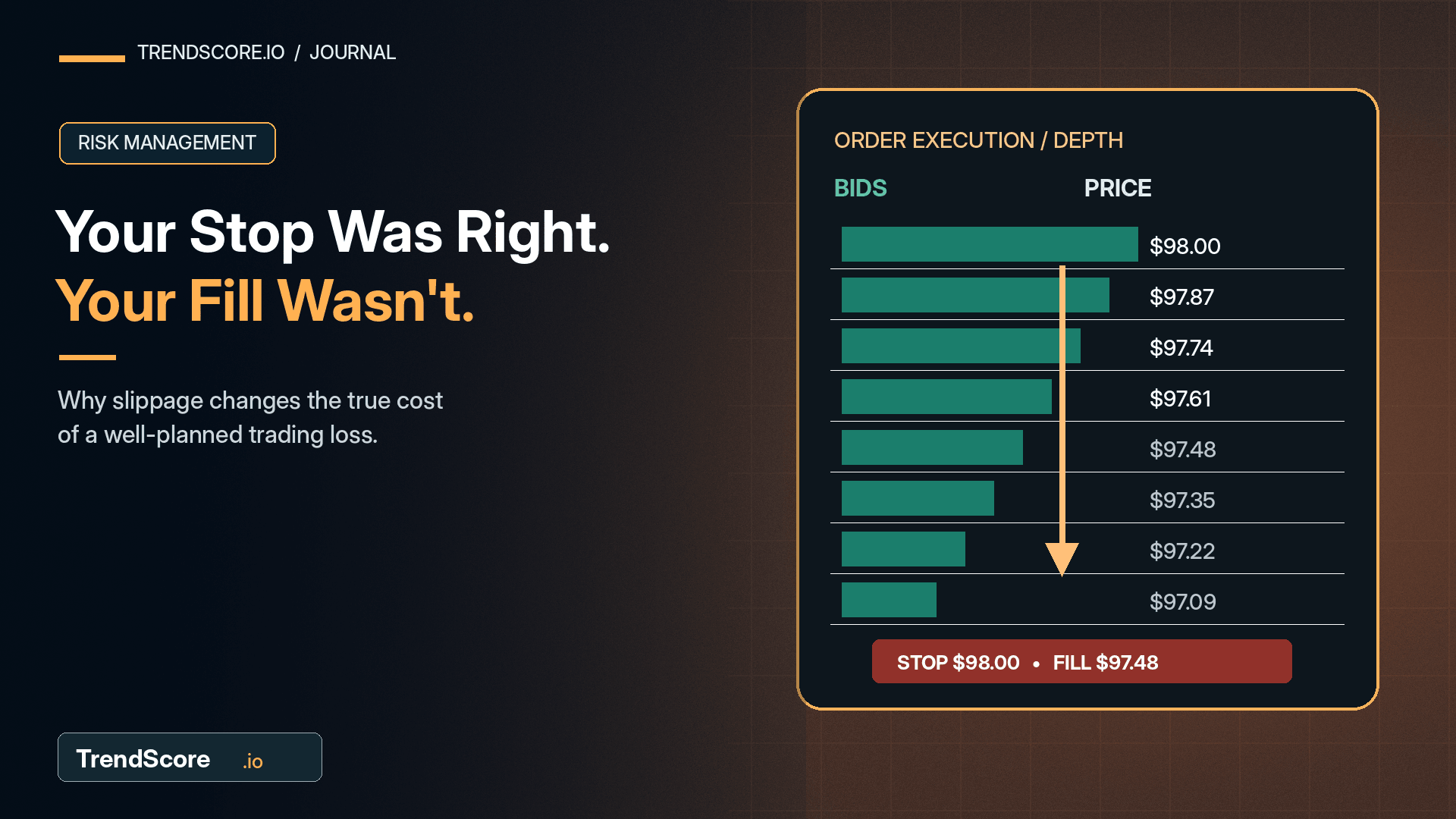
Your stop triggers at $98.
But by the time the exchange processes the resulting market order, the available bids may be substantially lower.
You could receive an average exit price of $97.40.
Instead of losing 2% of your position's notional value, you lose approximately 2.6%, excluding fees.
That additional 0.6 percentage point might look small.
If the position is large or heavily leveraged, it can make a meaningful difference to the trading account.
What actually happens inside the order book?
Every market transaction requires someone willing to buy and someone willing to sell.
When a trader submits a market sell order, the exchange matches it against available buy orders.
Those orders may be resting at different prices.
For example, an order book might contain buyers willing to purchase:
100 units at $98.00.
200 units at $97.95.
400 units at $97.80.
If you need to sell 600 units immediately, there may not be enough demand to complete the transaction at the highest available price.
Your order could consume multiple price levels.
The resulting average execution price is worse than the first price displayed on the screen.
This is market impact, one possible source of slippage.
The problem can become more severe when many traders try to exit simultaneously.
Stop-market versus stop-limit
These two order types are often confused.
A stop-market order is designed to initiate a market order once its triggering condition is met.
Its main advantage is that it prioritizes getting out of the position.
Its disadvantage is that the final execution price isn't guaranteed.
A stop-limit order submits a limit order when the stop condition is met.
It allows the trader to specify an acceptable execution price boundary.
But there is a trade-off.
If the market moves rapidly beyond the limit, the order may remain unfilled.
The trader retains the position while the market continues moving against them.
Neither type eliminates risk.
One prioritizes execution; the other prioritizes price constraints.
The appropriate choice depends on the strategy, market conditions and whether failing to exit would be more damaging than accepting an imperfect fill.
Why leverage makes the problem more serious
Leverage doesn't directly cause slippage.
But it amplifies the effect of adverse price movement relative to the margin committed.
Imagine a $10,000 position supported by $1,000 of margin.
A 2% move against the position represents approximately $200 before costs.
A 2.6% move represents approximately $260.
The difference is $60.
Relative to the original margin, that's another 6 percentage points of loss.
And if an adverse move is sufficiently severe, liquidation may occur before an ordinary planned exit can be completed.
The exchange's liquidation mechanism and mark-price rules also matter.
Traders should understand these details for the specific contracts they use.
The market can change between planning and execution
A trading plan is created using information available at a particular moment.
But liquidity isn't stationary.
During major announcements, order-book depth may decline and spreads may widen.
A market that normally handles substantial transactions smoothly can become difficult to trade during sudden volatility.
This is especially relevant for smaller cryptocurrencies, where even ordinary trading conditions may involve less depth than Bitcoin or Ethereum markets.
It is also why position size should be considered relative to available liquidity.
A large order in a thin market has a different execution profile from a small order in a deep market.
Build execution risk into the plan
There are several practical ways to improve the process.
Use realistic slippage and fee assumptions when calculating potential losses.
Avoid treating the stop price as a guaranteed maximum-loss boundary.
Examine typical spreads and order-book depth before opening unusually large positions.
Consider reducing exposure when liquidity appears unusually thin.
And evaluate whether the strategy is sensitive enough that modest execution differences could eliminate its expected advantage.
For systematic research, compare planned exit prices with actual simulated or live execution assumptions. A strategy that appears profitable before costs may become unattractive once realistic fills are considered.
Risk isn't finished when the stop is placed
A stop loss is an essential tool for many trading strategies.
But it isn't an insurance policy with guaranteed coverage.
Its effectiveness depends on the order type, market conditions, execution mechanism and available liquidity.
That is why TrendScore's structured Stop Loss levels should be understood as analytical invalidation points rather than promises about exact real-world execution.
The difference matters.
A trading plan tells you where you want to be wrong. Market execution determines how much being wrong actually costs.