
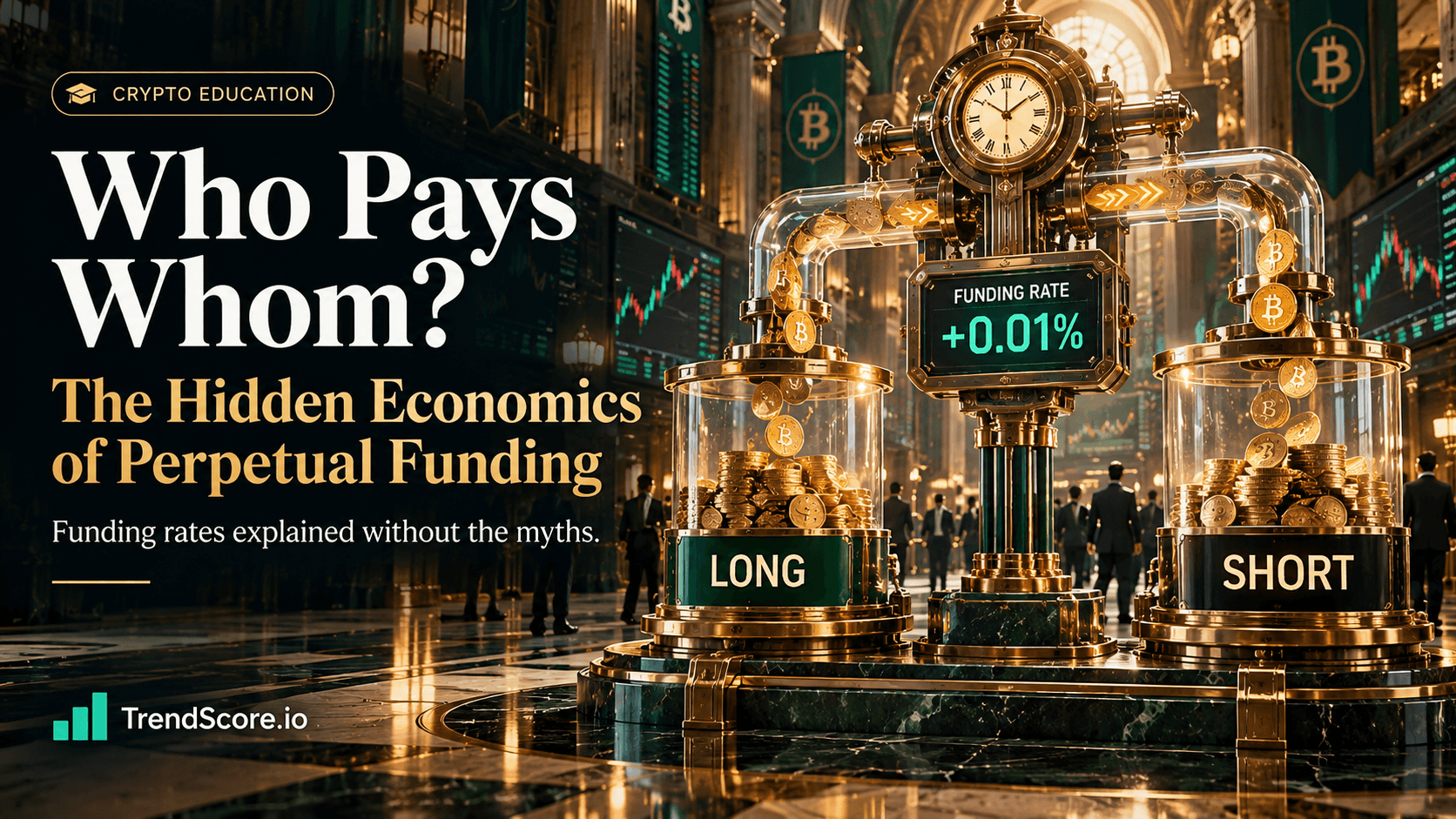
Funding rates explained without the myths.
Spend enough time around cryptocurrency futures traders and you'll hear people discussing funding rates.
"Funding is getting too positive."
"Shorts are paying."
"Everyone is overleveraged."
"This coin is about to squeeze."
Funding has become part of everyday crypto trading vocabulary.
But there's a surprising amount of confusion about what it actually measures.
A positive funding rate doesn't automatically mean a cryptocurrency is about to fall.
A negative rate doesn't guarantee a short squeeze.
And funding isn't simply a fee that an exchange collects for allowing someone to hold a position.
To understand what funding tells us, we need to understand why it exists in the first place.
Perpetual futures have an unusual problem
Traditional futures contracts generally have an expiry date.
As expiry approaches, the futures price tends to converge toward the price of the underlying asset.
Perpetual futures are different.
They don't have a scheduled expiry date.
A trader can theoretically maintain a position indefinitely, provided margin requirements continue to be satisfied and the position isn't otherwise closed.
But that creates a problem.
Without an expiry date, what encourages the perpetual contract price to remain reasonably close to the underlying spot market?
The answer is the funding mechanism.
Funding payments help discourage persistent differences between perpetual futures prices and the underlying spot price.
They do this by transferring payments between traders holding opposing positions.
The basic rule is surprisingly simple
When funding is positive, traders holding LONG positions pay traders holding SHORT positions.
When funding is negative, the direction reverses.
SHORT holders pay LONG holders.
The mechanism is influenced by the difference between perpetual futures prices and the underlying spot index, alongside exchange-specific calculation rules.
When perpetual contracts trade at a significant premium to spot, positive funding can make holding LONG positions more expensive.
When perpetual contracts trade at a discount, negative funding can increase the cost of maintaining SHORT exposure.
These incentives help discourage excessive divergence between the two markets.
The exchange facilitates the calculation and settlement, but funding should not be confused with ordinary trading commissions.
Here's where the mathematics gets interesting
Imagine a trader opens a perpetual futures position with a notional value of $20,000.
The funding rate at the next settlement is positive 0.01%.
The funding payment would be:
$20,000 × 0.0001 = $2
If the trader is LONG, they pay approximately $2.
If they are SHORT, they receive approximately $2, under this simplified example.
Now suppose the same rate applies across three eight-hour settlement periods.
The total funding transferred over the day would be $6.
That doesn't sound particularly dramatic.
But imagine the trader used $2,000 of margin to obtain the $20,000 exposure.
The $6 daily funding cost represents 0.3% of the original margin, assuming everything else remains unchanged.
Over multiple days, repeated funding payments can become meaningful.
And unlike this hypothetical example, actual funding rates can change significantly between settlement periods.
The payment also changes when position notional changes.
This is why evaluating funding relative to the full position exposure matters more than simply examining the percentage in isolation.
Funding is not a popularity contest
A common misunderstanding is that positive funding proves there are more LONG positions than SHORT positions.
But every futures contract has both sides.
There is a LONG and a corresponding SHORT.
The more useful interpretation concerns the relative willingness of participants to pay for particular exposure and the resulting relationship between perpetual and spot prices.
If traders are aggressively seeking leveraged bullish exposure, the perpetual contract may trade at a premium and funding may become positive.
That can provide information about demand and positioning pressure.
It doesn't reveal exactly how many individual traders are LONG or SHORT.
And it doesn't tell us whether the market is about to reverse.
High funding can persist during strong trends
Imagine a cryptocurrency experiencing a sustained bullish trend.
Demand for leveraged LONG exposure increases.
Funding becomes strongly positive.
Some traders immediately interpret that as a bearish signal.
But the market may continue rising for hours or days.
As long as buying pressure remains strong enough, traders may be willing to pay substantial funding costs to maintain exposure.
High positive funding can indicate increasingly expensive bullish positioning.
It doesn't establish that bullish positioning must immediately fail.
Similarly, negative funding can persist throughout a prolonged downtrend.
A crowded-looking trade can remain crowded much longer than an opposing trader expects.
Combine funding with price and open interest
Funding becomes more informative when examined alongside other market data.
Consider a hypothetical situation where price is rising, open interest is increasing and funding is becoming more positive.
That combination may suggest expanding derivatives exposure alongside increasing willingness to pay for bullish positioning.
Now consider a different scenario.
Price is rising, but open interest is falling.
That may reflect traders closing existing positions rather than large amounts of new exposure being established.
The interpretation becomes more complicated when liquidations and other position adjustments are involved.
Open interest does not identify the direction of every trader's exposure, and changes in it are not conclusive proof of any single explanation.
Still, considering these variables together creates a more complete picture than relying on funding alone.
Funding isn't free money
Some traders attempt to earn funding by holding positions on the side receiving payments.
For example, if funding is positive, holding a SHORT position may generate funding income.
But that income doesn't remove directional risk.
A cryptocurrency could rise far more than the funding payment earned by the trader.
There are also hedged approaches involving spot and perpetual positions, sometimes described as funding arbitrage or cash-and-carry strategies.
These require careful management of price differences, execution costs, collateral, liquidation risk and changes in funding.
Funding income is not guaranteed, and a seemingly attractive rate can disappear or reverse.
Three practical things to check
Before holding a perpetual futures position across funding settlement, it is worth understanding:
The current and estimated funding rate. This helps identify whether the position is expected to pay or receive funding.
The next settlement time. Funding schedules can differ between exchanges and contracts. Many contracts use eight-hour intervals, but shorter intervals also exist.
The position's full notional exposure. Funding calculations generally reference position value, not merely the amount of margin originally committed.
These details can affect the economics of a trade, particularly one intended to remain open over multiple funding periods.
A useful clue, not a trading signal
At TrendScore, understanding the mechanics of cryptocurrency markets matters because price movement is only one part of the trading environment.
Derivatives funding can provide valuable context when interpreted properly.
But it should never be mistaken for an automatic LONG or SHORT recommendation.
A positive rate isn't inherently bearish.
A negative rate isn't inherently bullish.
And a high rate isn't proof that a squeeze or reversal must occur.
Funding tells us something about the cost and pricing of perpetual exposure. Understanding what that means is far more useful than treating every positive or negative number as a prediction.