
A practical guide to market orders, limit orders and what actually happens when you press Buy or Sell.
You open a trading application.
Bitcoin is showing $90,000.
You decide to purchase $1,000 worth, press the Buy button and receive confirmation.
The resulting transaction shows an average purchase price of $90,018.
A small difference, perhaps, but an important one.
Why didn't you buy at the price displayed on the screen?
Because the number you see on a trading chart isn't necessarily the price available to execute your order.
And understanding that difference is fundamental to trading.
The last traded price is not a quotation for your order
When a trading platform displays Bitcoin at $90,000, that number often represents the price of the most recent transaction.
It doesn't mean someone is currently willing to sell you unlimited Bitcoin at exactly $90,000.
Actual trading takes place through available buy and sell orders.
The highest price a buyer is currently offering is called the bid.
The lowest price a seller is currently accepting is called the ask.
The difference between them is the bid-ask spread.
For example:
Best bid: $89,995.
Best ask: $90,005.
Spread: $10.
A trader placing an immediate market buy would generally transact against available sell orders, beginning with the ask.
Someone selling immediately would generally transact against available buy orders, beginning with the bid.
The displayed last price could be somewhere between those values—or temporarily outside them if quotes have changed since the last transaction.
This is why execution price and chart price are not always identical.
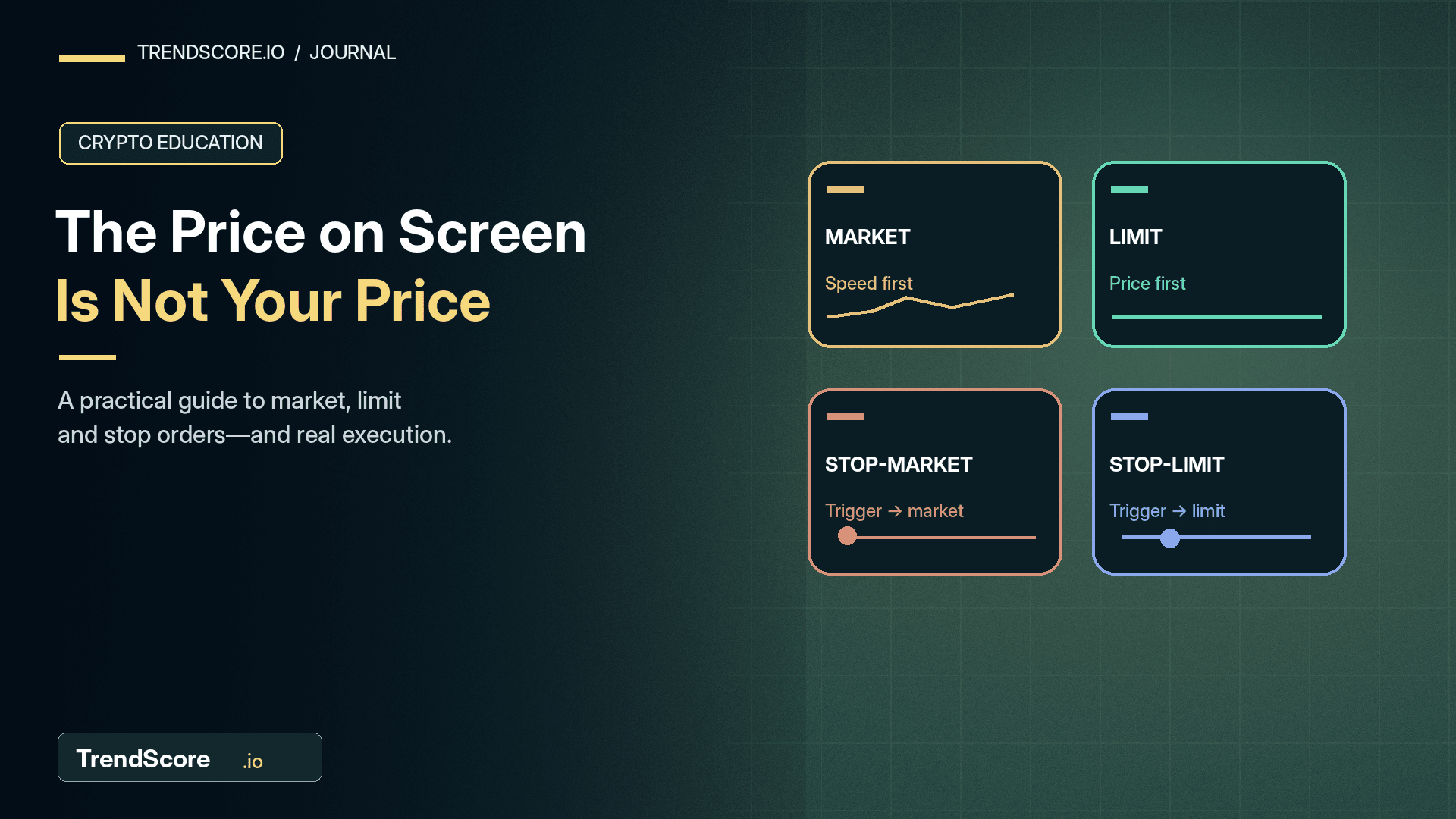
Market orders: prioritizing execution
A market order instructs the exchange to buy or sell using the available orders in the market.
Its primary advantage is speed.
If sufficient opposing liquidity exists and the exchange is functioning normally, the order can often execute quickly.
But a market order doesn't guarantee a particular price.
Suppose you submit a market buy for 1,000 units of a cryptocurrency.
The order book contains:
300 units offered at $10.00.
400 units offered at $10.01.
500 units offered at $10.03.
Your order could purchase 300 units at $10.00, 400 at $10.01 and the remaining 300 at $10.03.
The resulting average price would be $10.013 per unit, before fees.
The top ask was $10.00.
Your actual average execution price was higher because the requested quantity exceeded the amount available at the best price.
This is one reason larger orders can experience greater market impact.
Limit orders: prioritizing price
A limit buy allows the trader to specify the maximum price they're willing to pay.
A limit sell specifies the minimum acceptable selling price.
For example, a limit buy at $10.00 will not execute above that price.
That sounds attractive, and sometimes it is.
But here's the catch.
If the market moves from $10.05 directly to $10.50, the limit buy at $10.00 may never execute.
The trader avoids paying more than intended.
They also miss the move.
Even if the market briefly trades at $10.00, a limit order might receive only a partial fill—or no fill—depending on available liquidity, order priority and exchange matching rules.
A limit order controls an execution-price boundary.
It does not guarantee participation.
Stop orders serve a different purpose
Stop orders are often confused with ordinary limit orders because both involve choosing a price in advance.
But the function is different.
A stop order waits for a triggering condition.
For example, a trader holding a LONG position might place a stop-market sell instruction below the current market.
When the specified trigger is reached, the exchange submits a market sell order.
This can help automate a planned exit.
However, the resulting market order remains subject to slippage.
A stop-limit order works differently.
When the trigger condition is met, it submits a limit order.
That allows the trader to constrain the acceptable execution price, but the position may remain open if the market moves beyond that boundary.
An important detail is that exchanges may use different trigger-price references, including last traded price, mark price or index price, depending on the instrument and settings.
Traders should understand exactly which price activates their orders.
Maker and taker fees
Execution also influences transaction costs.
A trader who places a limit order that rests on the order book may provide liquidity.
This is commonly called a maker order.
A trader who executes immediately against existing orders removes liquidity.
This is commonly called a taker order.
Many exchanges apply different fee schedules to maker and taker transactions.
But a limit order isn't automatically a maker order.
If a limit buy is priced aggressively enough to execute immediately against existing sell orders, it may be treated as taking liquidity.
The fee treatment depends on the exchange's matching and pricing rules.
Over many transactions, these costs can materially affect a short-term strategy.
The choice depends on what matters most
Imagine two different situations.
A trader wants to exit a position because the original risk conditions have failed.
Execution may be more important than obtaining a perfect price.
Another trader is considering a new entry near a particular support area.
They may prefer a limit order because the setup only offers attractive reward-to-risk below a certain price.
Neither approach is universally superior.
The decision depends on the objective.
Do you prioritize immediate execution?
Do you need a particular price for the trade to remain worthwhile?
Can you tolerate an unfilled order?
What happens if the market moves rapidly against you?
These are execution questions rather than directional predictions.
Why simulated results need execution assumptions
This distinction is especially important when evaluating paper-trading performance.
A strategy might identify an entry at $10.00 and a target at $10.40.
If the simulation automatically assumes every entry fills at the intended price, results may look better than a live trading implementation could achieve.
Realistic evaluation should consider spreads, fees, available liquidity, unfilled limit orders and potential slippage.
For a strategy targeting very small price movements, these details may determine whether an apparent statistical advantage survives actual trading costs.
At TrendScore, scenario entry prices are useful analytical reference points.
They should not be mistaken for guaranteed real-world fills.
Knowing the direction is only half the job
A trader can correctly predict that an asset will rise and still execute the trade poorly.
They can enter at an unfavourable price, pay unnecessary fees or fail to account for the liquidity required to exit.
This is why understanding order mechanics is just as important as reading charts.
The chart shows you where transactions happened. The order book helps determine where your transaction can happen.
Confusing those two things is an expensive lesson.
Understanding the difference is one worth learning early.