
Why last price, index price and mark price aren't interchangeable in perpetual futures.
Imagine you're holding a leveraged Bitcoin LONG.
Your trading screen shows Bitcoin at $90,050.
You've placed a stop loss at $89,900.
Your estimated liquidation level is $89,850.
Everything seems reasonably controlled. You expect the stop to close the position before liquidation becomes a problem.
Then something unexpected happens.
The exchange begins liquidating the position even though the last traded price hasn't reached your stop-loss trigger.
It sounds impossible.
But depending on the exchange's rules and the trigger settings you've selected, it can happen.
The explanation begins with something many futures traders overlook.
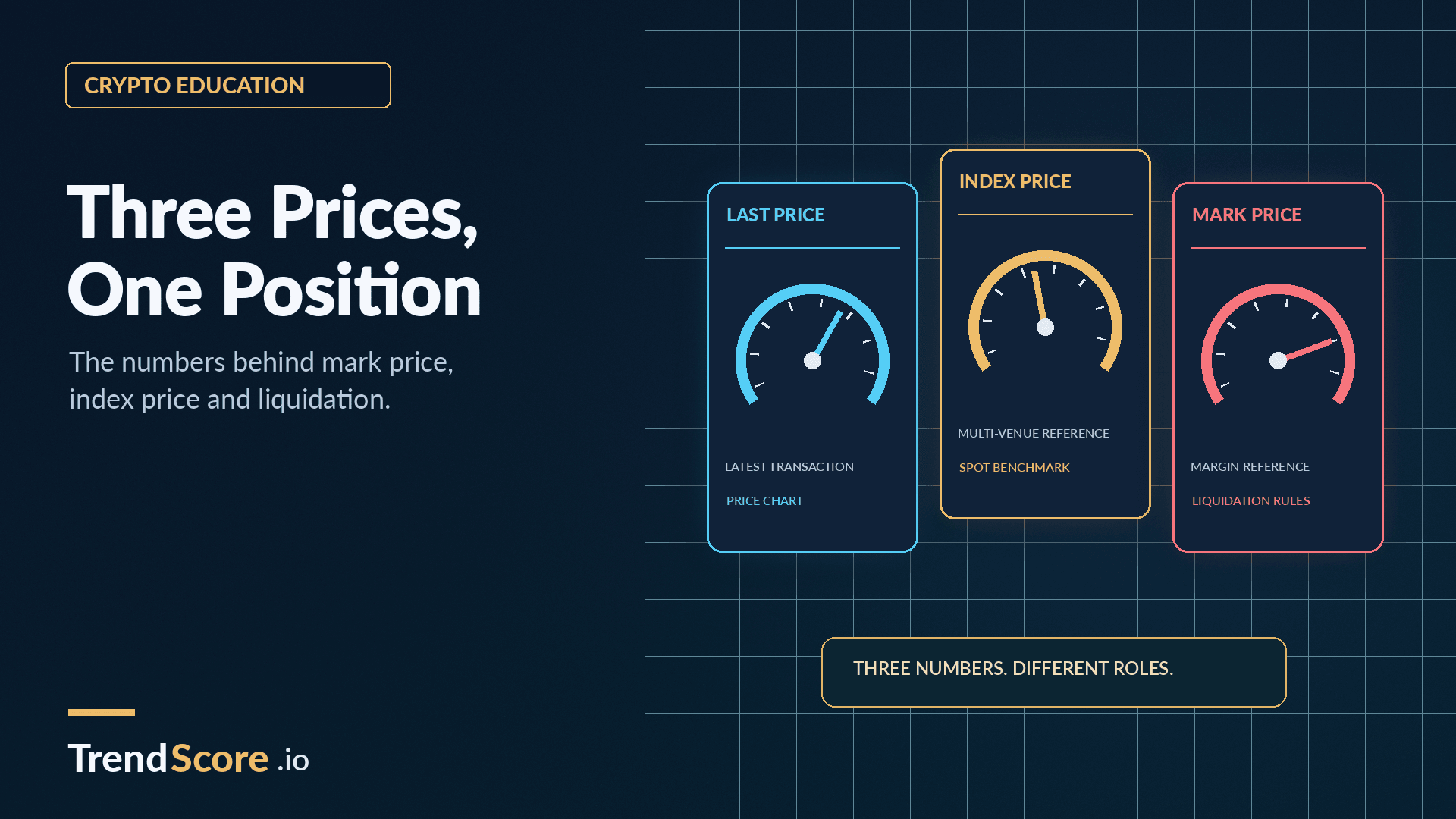
A perpetual futures contract can have several different prices at the same moment, and those prices serve different purposes.
The Last Price: What Actually Traded
The last traded price is the price of the most recent completed transaction for a particular contract.
If a buyer and seller transact at $90,050, that becomes the latest traded price until another transaction occurs.
It's the number traders naturally associate with the current market.
But it only describes where the most recent transaction happened on that venue.
It doesn't necessarily represent the broader value of Bitcoin across multiple exchanges.
And during unusual market conditions, a single derivatives market can temporarily trade above or below the wider market.
That's where another price becomes useful.
The Index Price: A Broader Reference
A cryptocurrency price index generally combines price information from multiple underlying spot-market sources.
The goal is to provide a broader reference value that is less dependent on the activity of one exchange.
Imagine Bitcoin trading at slightly different prices across several major spot venues.
An index aggregates selected price data according to the provider's methodology, which may include weighting rules and safeguards against abnormal inputs.
The resulting value serves as a reference point.
It isn't necessarily the price at which you could instantly buy or sell Bitcoin.
And the exact composition of an index varies between exchanges and contracts.
Its value lies in providing a benchmark less dependent on a single local transaction.
The Mark Price: The Number That Matters to Liquidation
Many major perpetual futures exchanges use a mark price to calculate margin-related risk and determine when a position becomes eligible for liquidation.
Mark price attempts to represent a fairer reference value for the derivative rather than relying solely on the last traded transaction.
Depending on the platform, its calculation can incorporate the underlying index, a funding-related adjustment and other contract-specific components.
Suppose the last traded price is $90,050 while the mark price is $89,840.
Your exchange may consider the position to have reached its liquidation threshold even though the last traded price remains above $89,900.
If your stop-loss order is configured to trigger using the last traded price, it may not activate first.
The apparent contradiction disappears once you understand that two different price references are being used.
The liquidation engine is watching one number.
Your stop trigger may be watching another.
The figures in this example are hypothetical, and the exact behaviour depends on the exchange's rules.
Why Exchanges Don't Simply Use Last Price
Imagine a thinly traded perpetual contract experiencing a temporary price spike.
A single aggressive order pushes the last traded price far away from the broader market.
If liquidation calculations depended entirely on that isolated transaction, positions might be liquidated because of a brief local dislocation.
Mark-price systems are designed to reduce that risk.
They aren't perfect, and they don't eliminate liquidations during volatile conditions.
But they provide an alternative to treating every temporary last-price movement as a reliable indicator of the contract's fair value.
This matters especially in leveraged markets where relatively small price differences can affect collateral requirements.
The Trigger Price Is Not the Execution Price
There's another distinction worth understanding.
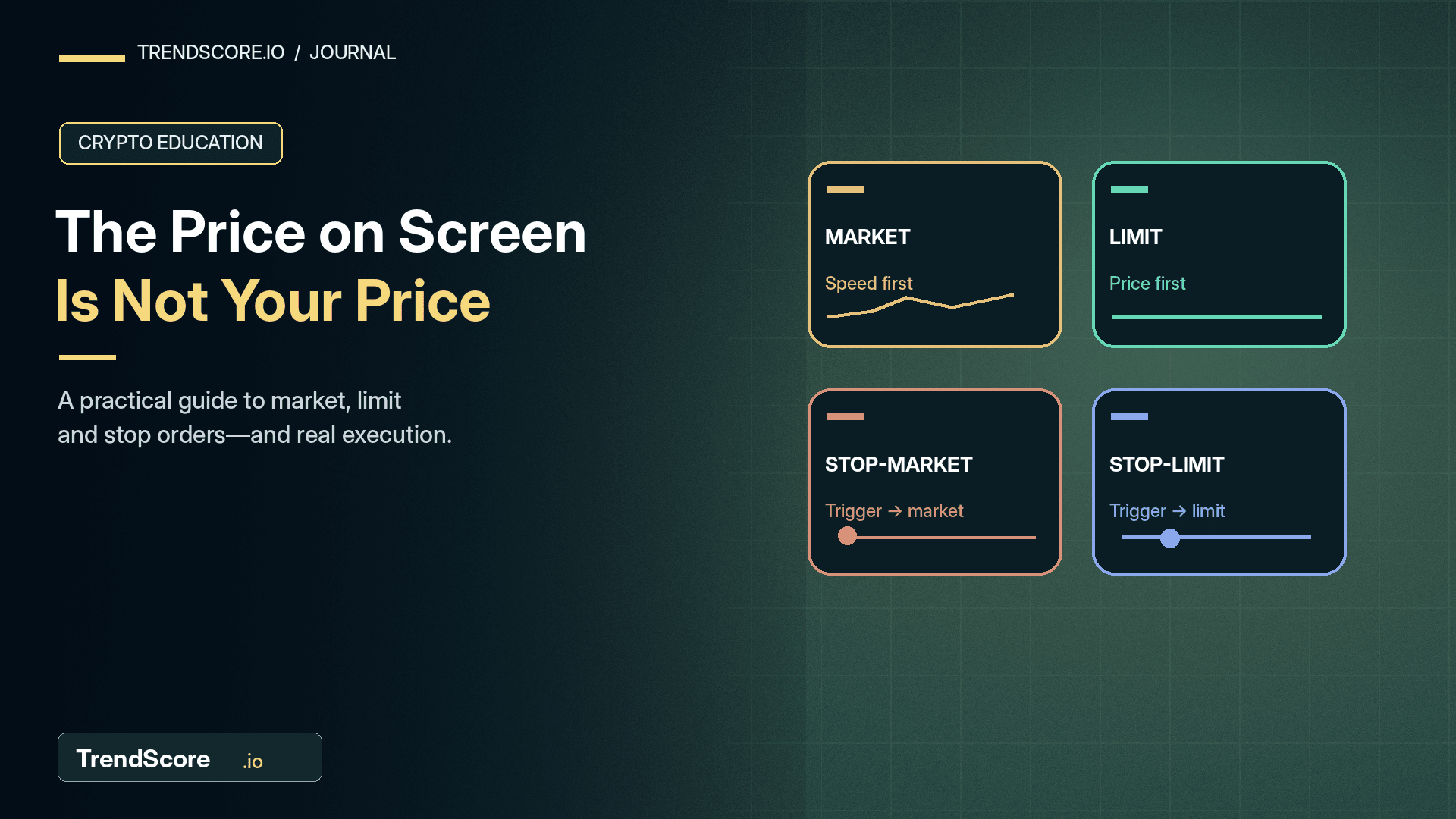
A stop order may have a trigger price and a separate execution mechanism.
For example, a stop-market order can be configured to activate when a selected price reference reaches a threshold.
Once triggered, the exchange submits a market order to close the position.
That order then executes against available liquidity.
The final fill price may differ from both the trigger price and the mark price because of spreads, slippage and changing market conditions.
Therefore, even choosing an appropriate stop trigger doesn't guarantee the intended exit price.
A liquidation threshold, stop trigger and actual fill are three separate concepts.
Liquidation Prices Can Change
Another misconception is that a liquidation price is permanently fixed when the position opens.
In practice, it can change according to the platform's margin model and the position's circumstances.
Adding or removing collateral can affect the available margin.
Changing position size can alter exposure.
Funding payments, account losses, changes in maintenance margin requirements and other account activity may influence the liquidation calculation.
Cross-margin positions can be particularly complex because collateral and exposure may be shared across positions.
A trader should not assume that a liquidation price observed at entry will remain unchanged indefinitely.
Three Checks Before Opening a Leveraged Position
Before using perpetual futures, examine the contract's price references.
Understand which price triggers liquidation.
Check which price reference your stop-loss order uses.
And understand how the exchange calculates margin requirements and estimated liquidation levels.
These details are not identical across every platform or contract.
A trader moving from one exchange to another should verify the new platform's settings instead of assuming they work the same way.
It's also worth remembering that placing a stop close to a liquidation level leaves little room for unexpected price differences or execution problems.
Risk planning should account for a range of adverse outcomes, not simply the ideal path shown on a chart.
The Chart Doesn't Show Every Part of the Position
Trading platforms make price action visually simple.
A green candle rises.
A red candle falls.
An entry line and stop-loss line appear on the screen.
But behind those visuals is a more complicated system involving reference prices, collateral, margin calculations, funding and order execution.
Understanding those mechanics can prevent mistakes that have little to do with predicting market direction.
TrendScore users studying leveraged trading scenarios should distinguish analytical entry and stop levels from the exchange-specific mechanics governing actual execution and liquidation.
Those mechanics deserve their own attention.
In perpetual futures, knowing where the market is trading is important. Knowing which price your exchange is actually using can be even more important when leverage is involved.