
Why days without trades deserve a place in serious trading-system research.
Imagine opening a market scanner that tracks hundreds of cryptocurrencies.
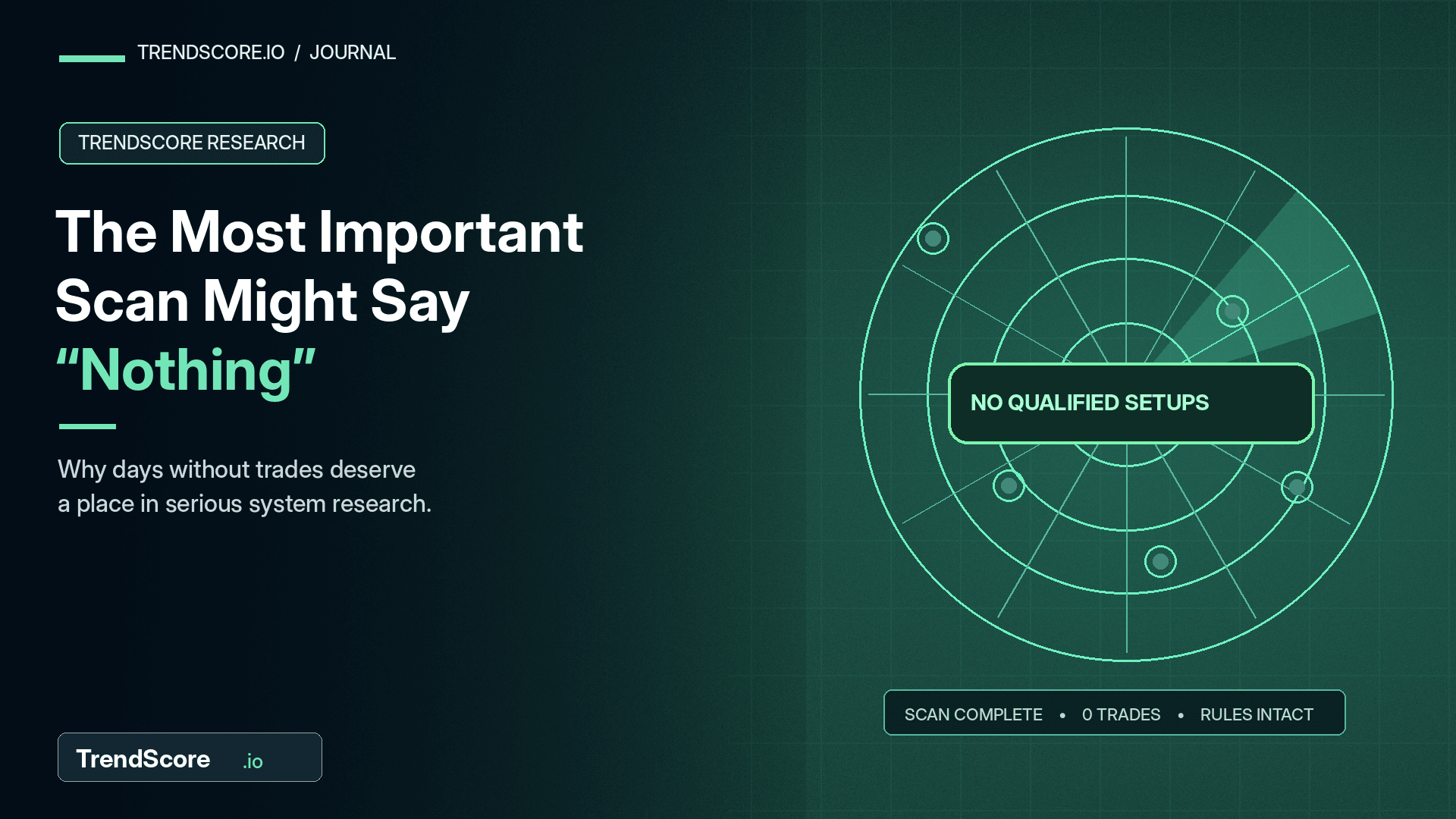
It finishes examining the market.
No strong opportunities appear.
No LONG scenarios qualify.
No SHORT setups meet the requirements.
Nothing.
For someone paying attention to financial markets all day, that can feel disappointing.
A scanner that returns no opportunities might seem less useful than one displaying twenty exciting possibilities.
But there's an interesting question hiding inside that disappointment:
What if finding nothing is exactly what a well-designed system should do under certain conditions?
This is an overlooked part of systematic trading research.
We're usually interested in the opportunities a strategy identifies.
We spend much less time examining the opportunities it deliberately rejects.
A scanner is a filter, not a vending machine
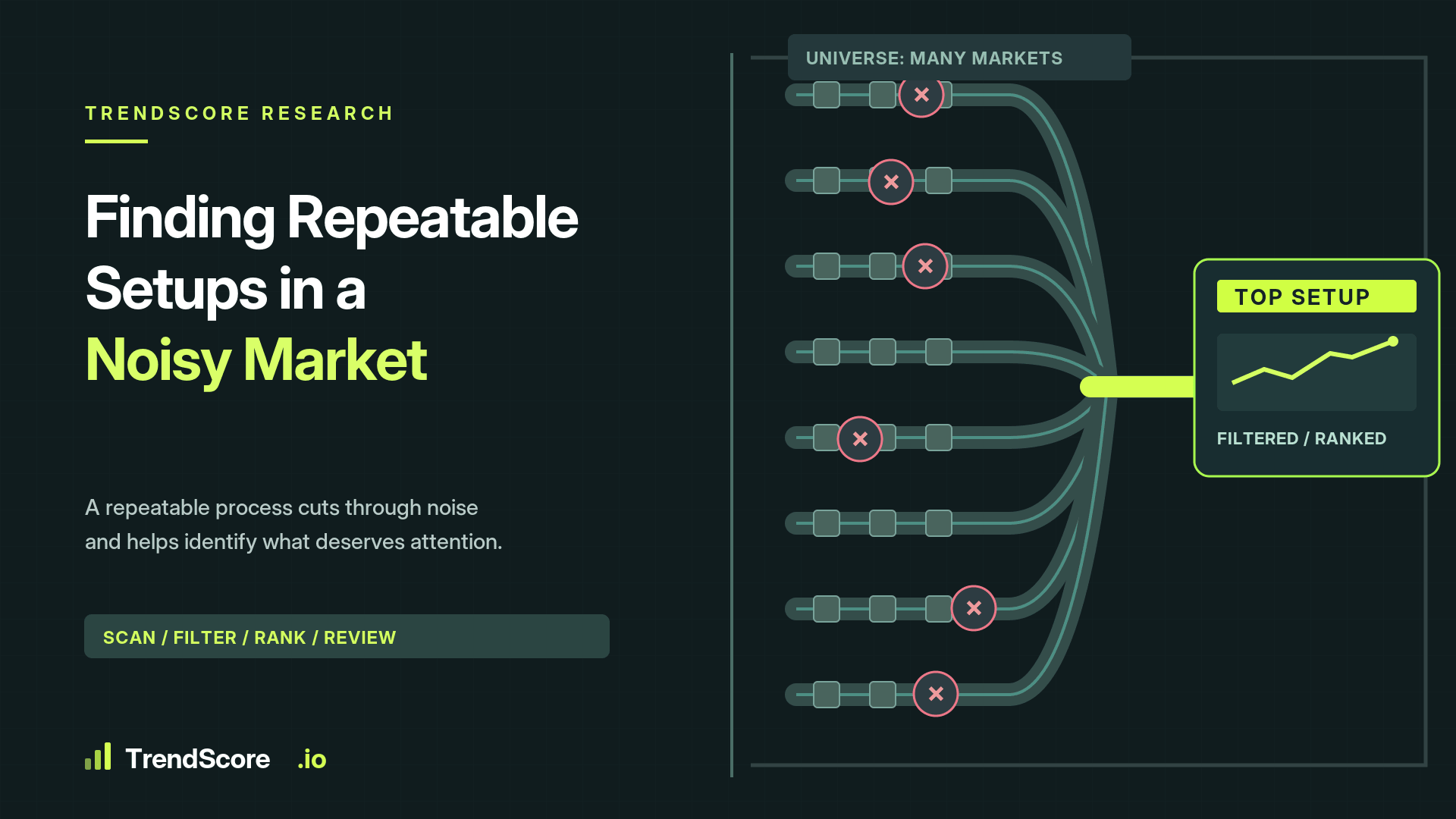
Imagine a system that evaluates 500 cryptocurrency pairs.
It examines trend conditions, momentum, volatility and other predefined variables.
At the end of the process, twelve assets receive particularly strong rankings.
The remaining 488 do not qualify.
Most discussions focus entirely on those twelve.
But the rejected candidates contain valuable information too.
Did the system exclude assets because their trends were unclear?
Were markets experiencing unusually unstable volatility?
Did prospective trades offer unattractive reward-to-risk ratios?
Were strong technical signals appearing in assets with insufficient liquidity?
Understanding the reasons behind rejection helps explain what the system is actually selecting.
It also creates opportunities to evaluate whether the filters are doing their intended job.
Sometimes the market simply isn't offering much
Not every market environment is equally favourable to every strategy.
A momentum-based method may struggle when prices repeatedly reverse within narrow ranges.
A breakout system may generate poor results when trading activity is weak and apparent breakouts fail to attract follow-through.
A strategy designed for calmer trends may have difficulty during violent, news-driven volatility.
In these environments, lower trading frequency can be an appropriate consequence of the rules.
That doesn't mean no profitable trades exist anywhere.
It means the available opportunities may not satisfy the conditions required by that particular methodology.
This is an important distinction.
A scanner doesn't need to claim that the entire market is unattractive.
It only needs to identify which conditions meet its own documented criteria.
The danger of forcing a daily quota
Imagine a system that ordinarily identifies between two and ten opportunities each day, depending on the market.
One afternoon, no setups qualify.
The developer decides this is a problem.
So the score threshold is lowered until five assets appear.
That might make the interface feel more active.
But it raises an important question.
Have market opportunities genuinely improved?
Or has the system simply reduced its standards to manufacture activity?
If the filtering criteria were based on meaningful analysis, relaxing them merely to produce more signals may damage the system's selectivity.
The scanner is no longer applying the same method consistently.
It's adjusting the rules according to the desire for an output.
This makes subsequent performance analysis more difficult.
No-trade days can reveal market regimes
Suppose a scanner produces strong candidates regularly during directional markets.
Then, over a particular period, the number of qualifying opportunities declines sharply.
That pattern could indicate something interesting.
Perhaps momentum has become inconsistent.
Perhaps volatility is no longer compatible with the strategy.
Perhaps market structure has become unusually fragmented.
Or perhaps the methodology itself is responding poorly to a new environment.
These explanations have different implications.
But tracking the frequency of qualifying signals creates another dimension of research.
Signal scarcity may contain information about the interaction between a strategy and current market conditions.
The claim would need testing, of course.
A decline in signal frequency isn't automatically a bearish indicator or a reliable predictor of future volatility.
It's simply a potentially useful observation.
How do you test whether rejecting trades helps?
This is where research becomes more interesting.
Imagine two versions of a hypothetical trading methodology.
Version A accepts every setup meeting basic technical conditions.
Version B adds stricter requirements for liquidity, volatility and reward-to-risk.
Version B produces fewer trades.
Does that make it better?
Not necessarily.
It might improve average trade quality.
It might also exclude profitable opportunities and reduce total returns.
The only responsible way to evaluate the difference is to examine results across a sufficiently large and representative sample.
That analysis should account for transaction costs, drawdowns, different market regimes and the possibility of overfitting.
It should also consider the capital that remains unused when trades are rejected.
Cash avoids trading losses, but it can carry an opportunity cost when markets move favourably.
A selective strategy must justify its selectivity through evidence rather than assuming fewer trades automatically means better performance.
Keep a record of what didn't qualify
One useful research practice is to record rejected candidates at the time the scan occurs.
For each candidate, preserve the market conditions, relevant scores and the reasons it failed to qualify.
Later, researchers can examine how those assets behaved.
Did excluded setups frequently fail?
Did some produce strong moves that the system consistently missed?
Were particular filters responsible for eliminating an unusually large number of otherwise attractive opportunities?
This creates a more complete picture of the scanning methodology.
There is one important caution: these observations should not be used to endlessly adjust thresholds until historical outcomes look perfect.
That would risk overfitting.
Any changes should be tested on separate data that was not used to design the revised rules.
The false-negative problem
Everyone understands why false positives are a problem.
A scanner identifies an attractive opportunity that subsequently fails.
But false negatives deserve attention too.
A false negative occurs when a system rejects a candidate that would have met a clearly defined standard of success.
For example, a conservative scanner might consistently overlook early-stage trends because it requires too much confirmation.
That doesn't necessarily make the scanner defective.
Early confirmation often involves greater uncertainty.
The question is whether the trade-off between rejecting weak opportunities and missing attractive ones is appropriate for the intended strategy.
This is a classic research problem.
Greater selectivity may improve precision while reducing the number of opportunities captured.
A useful evaluation should examine both effects.
What a meaningful scanning report might include
For a systematic platform, reporting only the number of profitable simulated trades provides an incomplete picture.
Additional information could include how many assets were examined, how many met the eligibility requirements, how many scenarios were generated and how many ultimately produced executable simulated entries.
It could also show how frequently the system produced no qualifying opportunities.
Those numbers would help users understand the scanner's behaviour, not merely its most successful outcomes.
At TrendScore, maintaining a distinction between scanning, ranking, scenario generation and simulated trade execution is especially useful.
A market observation is not necessarily a trade.
A high-ranking setup is not necessarily an entry.
And an empty scan is not necessarily evidence that the system has failed.
Sometimes restraint is the result
Financial platforms often feel pressure to display something exciting.
Another signal.
Another opportunity.
Another reason to act.
But analysis should be allowed to produce an inconvenient answer.
Sometimes the data is conflicting.
Sometimes risk is difficult to define.
Sometimes the available conditions simply don't satisfy the strategy.
A system that acknowledges those situations may be more informative than one that always finds a reason to participate.
The harder task is demonstrating, through careful research, whether that selectivity actually improves outcomes.
A good scanner shouldn't be judged by how often it tells you to trade. It should be judged by how reliably it applies its methodology—including on the days when the answer is nothing.