
Why the market's reaction to news can reveal more than the news itself.
A major economic announcement hits the wires.
Within seconds, Bitcoin jumps $1,500. Trading volume surges, liquidation alerts begin appearing, and social media fills with confident explanations about what happens next.
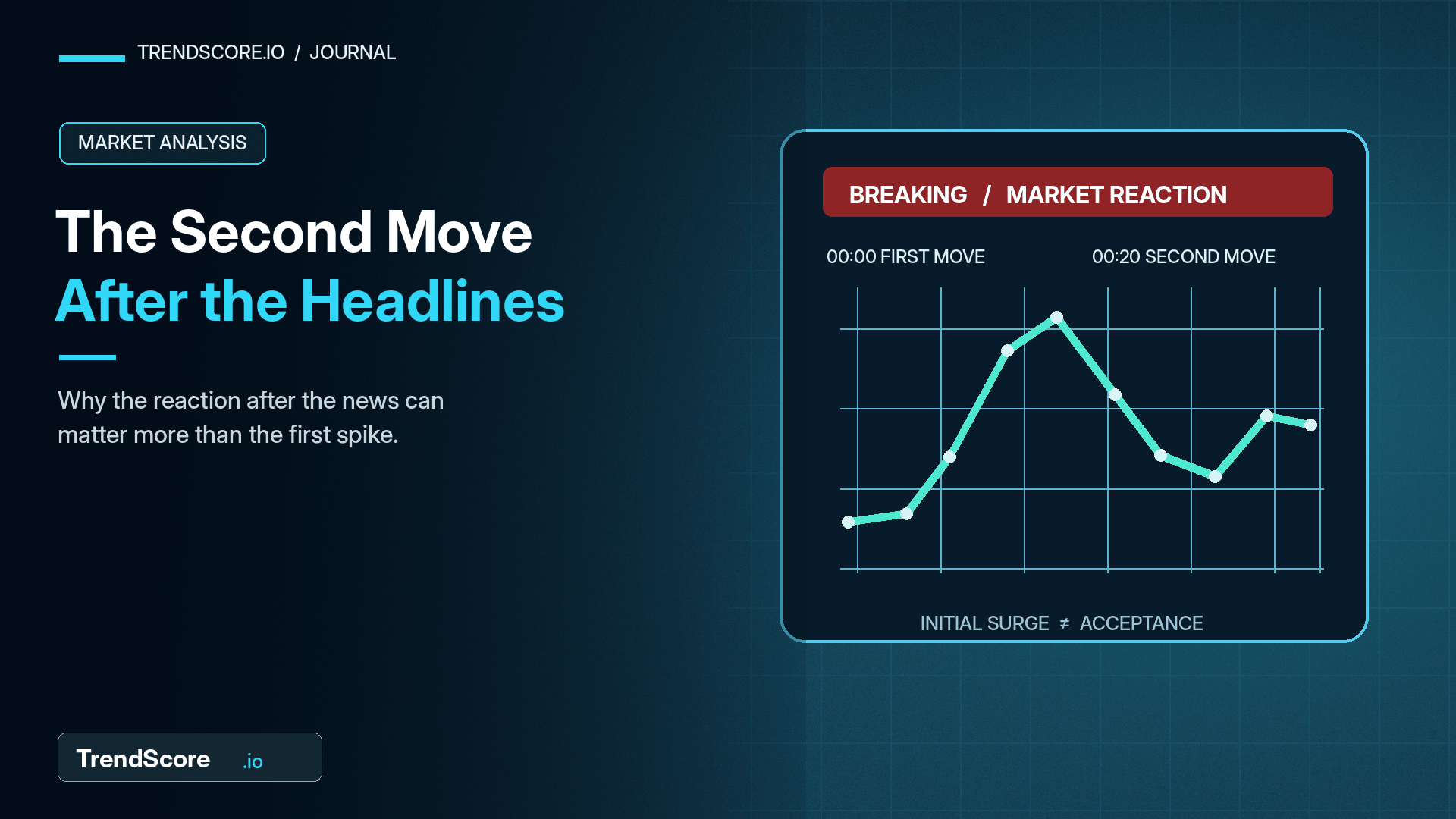
Twenty minutes later, Bitcoin has surrendered the entire move.
An hour later, it's trading in the opposite direction.
What happened?
The original news hasn't changed. The economic numbers are exactly the same. Yet the market has completely reconsidered how much those numbers are worth.
This is one of the most fascinating aspects of financial markets, and one that gets surprisingly little attention.
The first reaction tells you how traders responded to a surprise. What happens afterward tells you whether the market was willing to maintain that response.
Those are two very different things.
Markets trade expectations, not headlines
Suppose inflation is reported at 2.8%.
Is that bullish or bearish for Bitcoin?
You can't answer that question from the number alone.
If analysts expected 3.2%, the report represents a meaningful downside surprise. If they expected 2.5%, the same figure would represent an upside surprise.
Markets react to the difference between expectations and reality.
But even that is only the beginning.
Traders must also consider what the information might mean for interest rates, economic growth, bond yields, the dollar and broader risk appetite.
These relationships aren't constant.
A weak economic report might encourage expectations of lower interest rates, supporting risk assets.
Under different conditions, the same report could generate concerns about a recession and trigger selling.
The economic information is important, but the market's interpretation depends on the surrounding environment.
Why the first candle can be misleading
Immediately following a major announcement, markets can become unusually difficult to trade.
Algorithms react to incoming information. Traders rush to adjust positions. Some liquidity providers temporarily reduce their exposure or widen spreads because the appropriate price is uncertain.
This can produce abrupt movements in both directions.
A breakout occurring during these conditions may look extremely convincing on a chart.
Large candles. Rising volume. A clear break above resistance.
But the movement may be driven partly by temporary order imbalances rather than sustained buying interest.
Once the initial wave of orders has passed, the market begins reassessing the new price.
That's where the second move becomes interesting.
Imagine three possible outcomes
Bitcoin is trading around a hypothetical $90,000 before an important announcement.
News arrives, and price immediately rises to $91,500.
What happens next can take several forms.
Scenario A: Price holds the new range.
Bitcoin pulls back modestly, finds buyers near $91,000 and begins making higher lows.
This suggests the market is accepting prices above the previous range.
It doesn't guarantee continuation, but it provides evidence that the initial bullish response has attracted further participation.
Scenario B: The entire move disappears.
Bitcoin jumps to $91,500, then gradually returns to $90,000.
Buyers who entered during the initial surge may now be reconsidering their positions.
The failed move becomes informative because the market was unable to sustain the initial repricing.
Scenario C: The market reverses aggressively.
Bitcoin rises toward $91,500, stalls and then breaks below $89,500.
This may indicate that the original reaction was overwhelmed by opposing positioning, broader risk considerations or changes in available liquidity.
The important observation is that all three scenarios began with the same bullish candle.
A trader who entered exclusively because of that first movement had very little information about which outcome would follow.
The role of liquidity during news events
Liquidity conditions can make the difference between an orderly adjustment and a chaotic price spike.
During major announcements, bid-ask spreads may widen and visible order-book depth may decline.
A market order that normally causes very little price movement can produce substantial slippage when fewer orders are available.
Stop-market orders can also execute at worse prices than expected.
This makes leverage particularly unforgiving.
A trader might correctly anticipate the eventual direction of the market and still suffer a loss because the initial volatility triggers their stop or liquidation threshold.
Being correct about a broader market reaction is not enough if the position cannot survive the path price takes to get there.
What traders should examine after the first reaction
Rather than rushing to interpret the first candle, it may be more useful to observe the market's subsequent behaviour.
Does price remain outside the previous trading range?
Does volume remain elevated after the immediate announcement?
Are Bitcoin and major altcoins moving together, or is the reaction increasingly fragmented?
Does the market maintain its direction after the initial burst of liquidations?
And perhaps most importantly, does the available entry still offer a reasonable relationship between potential reward and risk?
These observations can help distinguish a sustained change in market behaviour from a temporary emotional response.
Waiting carries a cost, of course. Sometimes the first move continues without offering another attractive entry.
That's an opportunity missed, not necessarily a mistake.
The market has the final word
Financial news matters. Economic data matters. Central bank decisions and regulatory developments can materially alter asset valuations.
But a headline isn't a trading strategy.
The same announcement can produce different outcomes depending on existing positioning, liquidity, expectations and the broader market environment.
For systematic analysis, the question is not simply whether news is positive or negative. It is whether the market's subsequent behaviour supports a measurable trading scenario.
This is especially relevant to TrendScore's approach of evaluating market structure, momentum and predefined risk rather than relying on directional opinions alone.
The first candle after major news is often the loudest. The next several candles may tell you considerably more.