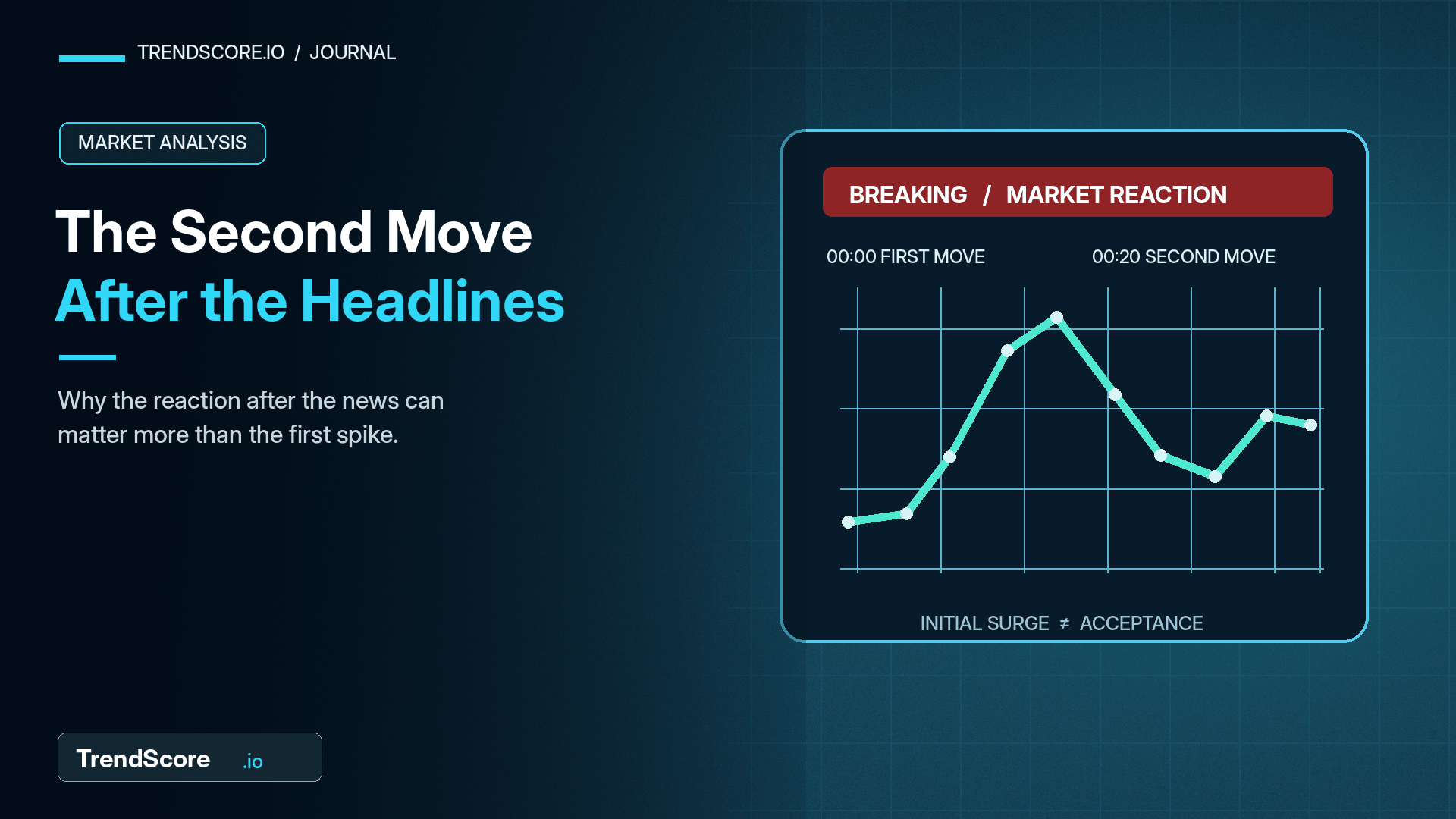


The hidden rhythm behind a 24/7 market.
One of cryptocurrency's biggest selling points is that the market never closes.
You can buy Bitcoin on Sunday morning, short Ethereum at midnight, or trade altcoins while traditional stock exchanges are closed for the weekend.
There are no opening bells. No closing auctions. No waiting until Monday for the market to reopen.
But here's something that deserves much more attention than it usually receives:
A market being open 24 hours a day doesn't mean trading conditions are equally good throughout those 24 hours.
And that distinction can have a surprisingly large influence on trading results.
The market has a daily rhythm
Although cryptocurrency trading is continuous, the people and institutions participating in it still operate in different time zones.
Asian trading desks become active during their business day. European participants follow, and American markets introduce another major period of activity.
These sessions overlap at certain times, creating periods when multiple financial centres are active simultaneously.
At other times, participation may become thinner.
This doesn't mean that every American session is volatile or that every Asian session is quiet. The pattern changes with market conditions, global news, exchange activity and the assets being traded.
But trading activity and liquidity are not distributed evenly across the clock.
That creates an interesting situation: the same technical setup can behave differently depending on when it appears.
Imagine two identical breakouts
Let's take a hypothetical example.
Bitcoin is trading near $90,000 and approaching a resistance level at $90,500.
During an active trading period, price breaks above resistance while several major exchanges experience increasing volume.
Order books remain relatively deep, spreads are controlled and the move attracts continued participation.
Now imagine exactly the same breakout occurring during a much quieter period.
Price crosses $90,500, but fewer resting orders are available around the market. A relatively modest amount of buying produces a disproportionately large movement.
The second breakout might initially appear more impressive because price jumps faster.
But the speed of the movement doesn't necessarily indicate stronger underlying demand.
In a thin market, price can travel rapidly in either direction.
The difference matters when traders are evaluating the quality of a breakout rather than simply its size.
Weekends deserve special attention
Weekend trading adds another interesting dimension.
Traditional financial markets generally operate on weekday schedules, while cryptocurrency exchanges remain open.
Professional participants, institutional trading desks and liquidity providers may adjust their activity and risk exposure outside normal business hours.
This can influence the depth and behaviour of certain crypto markets.
A weekend with reduced liquidity can experience sudden price movements when unexpected news or aggressive orders arrive.
But the opposite can also happen: major weekend events may generate exceptionally high trading activity.
The important point is not that weekends are automatically dangerous.
It's that traders should avoid assuming weekend conditions are identical to those observed during busy weekday sessions.
Volatility and liquidity are not interchangeable
Another common misunderstanding is the idea that low volatility means a market is safe.
A cryptocurrency might remain almost motionless for several hours because little trading activity is taking place.
That can look reassuring.
But if order-book depth is limited, a sudden large order may move price much further than expected.
Conversely, a market experiencing significant volatility can still maintain strong liquidity if buying and selling activity is sufficiently deep.
These two concepts describe different things.
Volatility tells us how much price is moving.
Liquidity tells us how easily transactions can occur without causing substantial price changes.
A trader needs to understand both.
Why timing matters to stop losses
Consider a short-term trading strategy that typically uses tight stop losses.
If the strategy was developed using data from highly liquid periods, its results may not transfer cleanly to quieter conditions.
Bid-ask spreads can widen.
Slippage can increase.
A stop-market order may execute at a worse price than the trader expected.
Even when the directional analysis is reasonable, changes in execution conditions can alter the outcome.
This is particularly relevant to leveraged trading, where relatively small differences in price can materially affect returns.
A setup isn't necessarily invalid because it occurs at an unusual hour.
But its execution risks deserve attention.
A practical way to study the market clock
Rather than declaring one trading session universally superior, traders can examine their own results.
Record when each setup appears, along with its volatility, volume, spread and eventual outcome.
Then compare similar setups across different trading periods.
Do breakout strategies perform differently during quieter hours?
Are stop losses triggered more frequently during particular session transitions?
Does the behaviour vary between Bitcoin, Ethereum and smaller altcoins?
The answers may differ according to the strategy and asset.
That's precisely why measurement is useful.
At TrendScore, the broader principle behind systematic scanning is that market opportunities should be evaluated through observable conditions rather than assumptions.
Time of day can be one additional dimension worth investigating.
It should not replace trend, momentum, volatility or risk analysis, but it can help explain why apparently similar opportunities produce different outcomes.
The market is always open. Your strategy doesn't have to be.
One of the greatest advantages of cryptocurrency is the freedom to participate whenever you choose.
But that freedom can also encourage traders to treat every hour as equally deserving of their attention and capital.
It isn't.
A disciplined approach recognizes that market conditions change throughout the day, even when the exchange never closes.
Sometimes those changes improve opportunities.
Sometimes they introduce risks that aren't obvious from the price chart alone.
Crypto trades around the clock. Understanding when and how the market changes may be more valuable than simply having the ability to trade at any moment.