
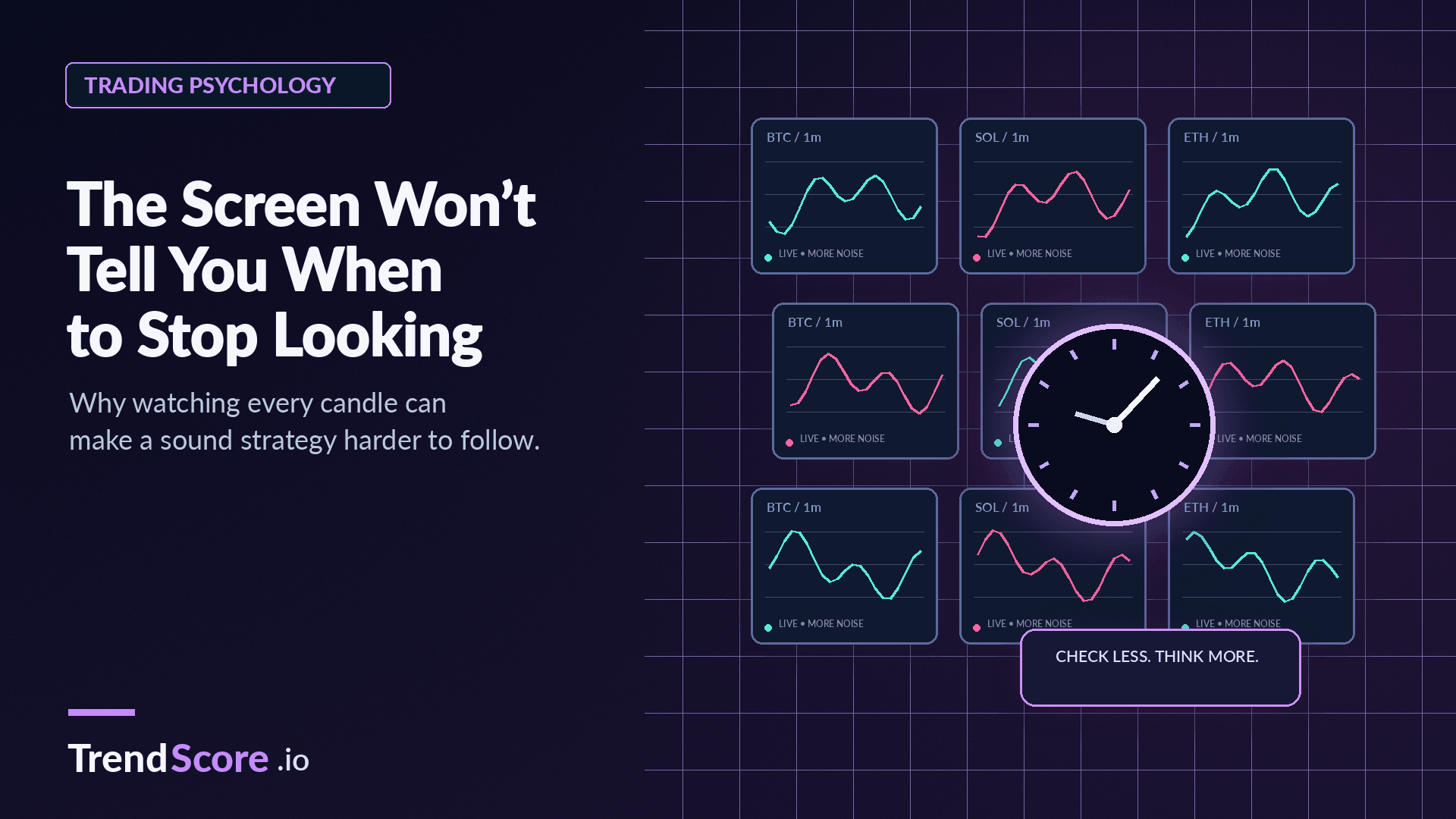
Why watching every candle can make a perfectly reasonable trading strategy harder to follow.
There is a strange contradiction in modern trading.
We have better information, faster charts, more indicators and almost unlimited access to markets.
Yet having more information available doesn't necessarily make us better at using it.
Sometimes it creates the opposite problem.
A trader identifies a good setup, opens a position and establishes a reasonable stop loss and profit target.
The plan is clear.
Then they begin watching.
One candle turns red. The next turns green. A sudden wick appears. The order book changes. An analyst publishes a bearish opinion, and Bitcoin moves slightly lower.
Nothing particularly important may have happened.
But after fifteen minutes of staring at the screen, the trader has already reconsidered the position six times.
This is the hidden cost of over-monitoring.
More Information Isn't Always More Relevant Information
Imagine a trader using a four-hour strategy.
Their analysis depends on the direction of the four-hour trend, the completion of a particular candle and whether price holds an important structural level.
Those conditions do not meaningfully change every thirty seconds.
But if the trader watches a one-minute chart continuously, they will see hundreds of small fluctuations before the next four-hour candle closes.
Each fluctuation invites interpretation.
A sudden one-minute decline appears threatening.
A quick recovery feels encouraging.
A brief breakout creates excitement.
The problem is that most of these movements may be irrelevant to the original strategy.
The trader is using one timeframe to make the decision and another to generate anxiety about it.
The Market Doesn't Know You're Watching
There's a psychological illusion that develops when people monitor something continuously.
Watching creates a feeling of involvement.
You start believing that by observing every movement, you somehow have more control over the outcome.
But staring at a chart doesn't influence its direction.
It doesn't improve the original setup.
And unless new information requires action, it doesn't necessarily improve execution.
What constant monitoring can do is increase the number of moments in which the trader feels compelled to make a decision.
That matters because every unnecessary decision introduces another opportunity to abandon the plan.
A Good Position Can Become a Bad Decision
Consider a hypothetical trade.
A trader enters at $100, establishes a stop at $96 and a target at $108.
The setup is intended to develop over several hours.
After entering, price falls to $99.20.
The trader becomes nervous and closes the position.
Thirty minutes later, the asset returns to $101.
Frustrated, the trader buys again, this time at $101.50.
Price then retraces to $100.30.
The trader closes again.
Eventually, the market reaches the original target of $108.
The initial analysis was broadly correct.
But repeated monitoring created two unnecessary exits and an increasingly emotional sequence of decisions.
Of course, the opposite can happen. An early exit can prevent a larger loss.
The point isn't that traders should never reassess positions.
It's that changes to a trade should be triggered by meaningful evidence, not simply the discomfort of watching ordinary price fluctuations.
Timeframe Discipline Is Psychological Discipline
A useful habit is to match monitoring frequency to the timeframe and conditions of the strategy.
A scalper trading one-minute movements may legitimately need continuous attention.
A trader using four-hour candles may not.
Someone holding positions for several days might reasonably rely on predefined alerts and scheduled reviews rather than repeatedly checking every minor movement.
The monitoring schedule should reflect what information can actually change the trading decision.
For example, a strategy might require a review when a candle closes, a predefined price alert activates or market conditions materially change.
This reduces the temptation to reinterpret the plan after every tick.
It doesn't remove risk.
It simply gives attention a purpose.
Alerts Should Have Meaning
Modern trading platforms allow alerts to be configured around prices, technical conditions and volatility changes.
Used well, these tools can reduce unnecessary screen time.
Used badly, they create a constant stream of interruptions.
An alert that sounds every time Bitcoin moves 0.2% may be unhelpful for a strategy that tolerates 3% fluctuations.
A more useful alert is tied to a specific decision.
Price approaches a planned entry zone.
An important structural level is breached.
A profit objective is reached.
The conditions supporting a setup materially change.
The alert should answer the question: Why does this information require my attention?
If there is no good answer, the alert may simply be noise.
There's Also a Cost to Decision Fatigue
Trading requires repeated judgments under uncertainty.
Should the position remain open?
Has momentum weakened?
Is this pullback normal?
Should exposure be reduced?
When those questions are reconsidered dozens of times without meaningful new information, the decision-making process can become less consistent.
Fatigue doesn't always make traders obviously reckless.
Sometimes it makes them overly cautious.
Sometimes impatient.
Sometimes unable to distinguish important changes from ordinary fluctuations.
A trader can become exhausted even during a session in which very little actually happens.
Reducing unnecessary decisions can help preserve attention for the moments when it matters.
Learn to Review the Trade Without Reliving Every Candle
One practical exercise is to compare two records.
First, document the trading plan made before entering.
Second, record every intervention made while the position was open.
Then ask whether each intervention followed from a meaningful change in the original conditions.
If a trade was closed because the planned invalidation level was reached, that's understandable.
If it was closed because three consecutive one-minute candles looked uncomfortable while the four-hour setup remained intact, the reasoning deserves examination.
The objective isn't to prohibit discretion.
It's to make discretion accountable.
Attention Is a Limited Trading Resource
TrendScore's structured analysis can help organize potential scenarios before a position is opened.
But even a strong analytical framework can be undermined if the trader continually replaces its rules with impulsive reactions.
The challenge isn't always finding more market information.
Sometimes it's deciding which information deserves attention.
A trader doesn't become more disciplined simply by watching the market more closely. Discipline begins when attention is directed toward the evidence that can genuinely change the decision.