
How publishing a prediction can quietly change the way you manage it.
Before social media, most traders could be wrong in private.
They might discuss a position with a friend or record it in a personal journal, but there was rarely an audience watching every decision unfold.
Crypto changed that.
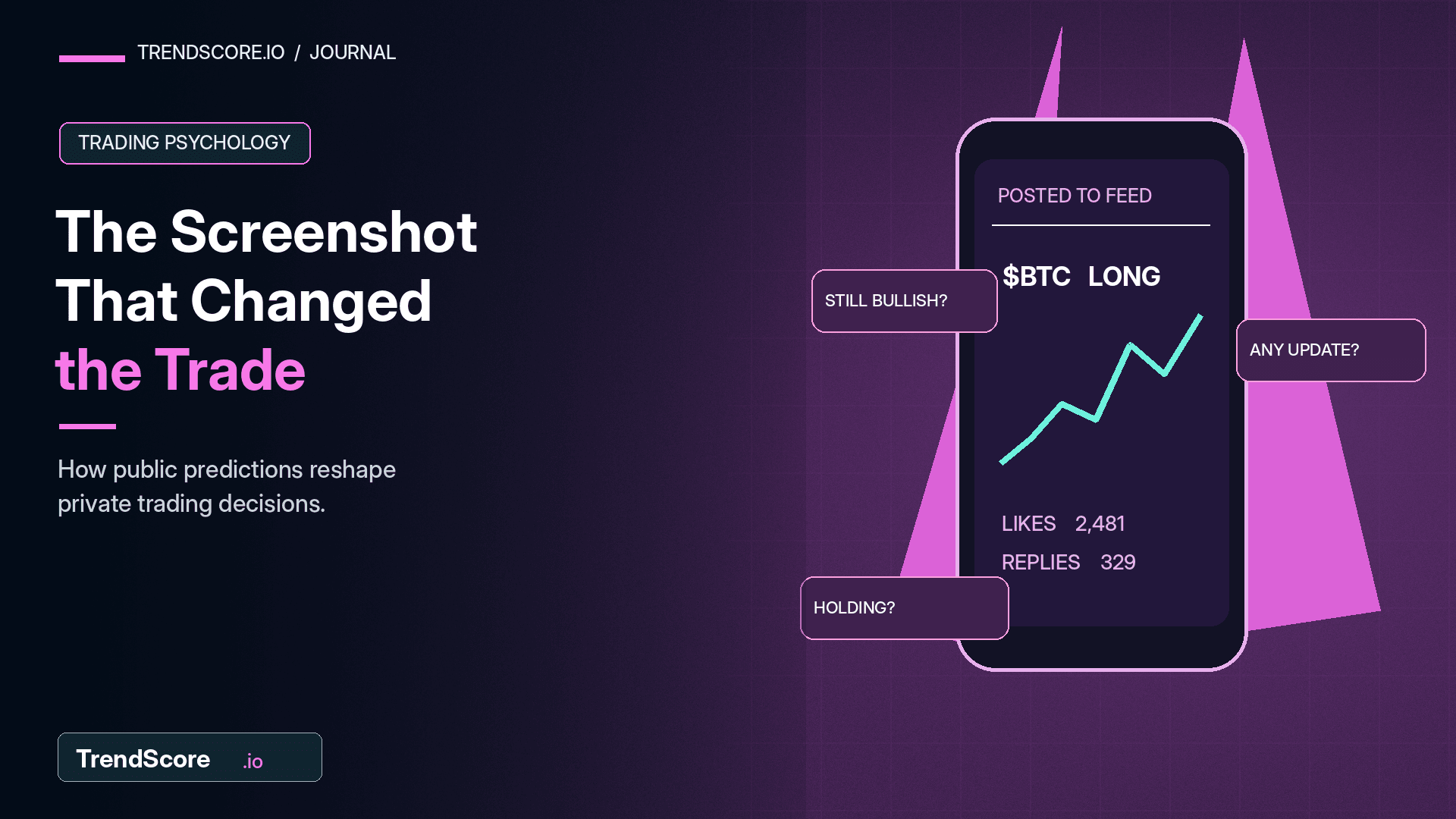
Today, a trader can open a position and publish it to thousands of people within seconds.
A screenshot shows the entry.
A caption explains the conviction.
Followers start commenting.
Some agree. Others challenge the analysis. A few may even enter similar positions.
Suddenly, something interesting happens.
The original trading decision is no longer just about the market.
It's also about the trader's public reputation.
The moment a prediction becomes an identity
Imagine someone posting:
"Bitcoin is going to break $95,000 today. This setup is obvious."
At the time, the person genuinely believes the analysis is strong.
Then Bitcoin begins moving lower.
Ordinarily, the trader might review the setup and close the position when the original conditions are invalidated.
But now there's an audience.
People are waiting for the outcome.
Some have already shared the post. Others are asking whether the trader still believes in the prediction.
Admitting the idea was wrong may feel embarrassing.
So the trader begins looking for explanations.
The expected breakout becomes a temporary delay.
The short-term position becomes a swing trade.
The stop is moved because the market supposedly needs more room.
A trade that originally had clear conditions has slowly become something that must be defended.
Not necessarily because the market offers new evidence, but because the trader has publicly committed to a particular outcome.
The audience changes the incentives
This is an important distinction.
A disciplined trader should ideally be rewarded for making sensible decisions, whether the individual trade wins or loses.
Social media tends to reward something different.
Certainty.
Confidence.
Spectacular returns.
Bold predictions.
A post saying "this scenario has several possible outcomes and I'll reconsider below the invalidation level" may attract less attention than "this coin is about to explode."
But the more dramatic statement also creates greater pressure to appear correct.
That pressure can influence trading behaviour, particularly when someone's online identity is built around successful calls.
The objective subtly shifts from following a process to maintaining an image.
A winning screenshot tells an incomplete story
Consider a trader who publishes ten potential setups.
Three become extremely profitable.
Four lose.
Two never reach their intended entries.
One remains unresolved.
If the trader posts screenshots of the three winners, the content may be entirely genuine.
But anyone seeing only those screenshots receives a very selective picture.
That doesn't necessarily mean the creator is dishonest.
People naturally share outcomes that make them feel successful.
The problem begins when highlighted results are interpreted as representative performance.
A particularly strong screenshot says very little about consistency, drawdowns or the risk taken to achieve it.
For meaningful evaluation, the full record matters.
Public accountability can also be useful
None of this means traders should stop discussing their positions publicly.
Publishing an analysis can create healthy accountability when done properly.
A timestamped prediction makes it harder to rewrite the original thesis after the fact.
A clearly defined invalidation level makes the reasoning easier to evaluate.
And discussing losing positions can be just as educational as celebrating successful ones.
The issue isn't the audience itself.
It's whether public attention changes the rules of the trade.
One useful principle is to distinguish between sharing an analysis and performing confidence.
The first invites examination.
The second invites emotional attachment.
A better way to publish trading ideas
Before posting a setup, define the conditions clearly.
Explain what supports the idea.
Identify the timeframe.
Specify what would invalidate the scenario.
And avoid turning a probabilistic observation into a promise.
If the setup fails, record the outcome without rewriting the original thesis.
If it wins, explain whether execution followed the plan.
These habits are especially relevant to communities built around rankings, simulated trading competitions and shared portfolio performance.
Competition can encourage learning and engagement, but it can also reward excessive risk-taking if traders become too focused on leaderboard positions.
A visible result is not automatically a high-quality decision.
Don't let the post manage the position
The most revealing question is simple.
Would I make the same trading decision if nobody knew I had entered this position?
If the answer is no, public pressure may be influencing the trade.
At TrendScore, recorded scenarios and simulated outcomes offer an opportunity to discuss trading ideas in a more transparent way.
The value is not pretending every prediction will succeed.
It is making decisions measurable enough that both successes and failures can contribute to learning.
A trading idea shouldn't become harder to abandon merely because it received more likes. The market hasn't changed its rules because you published yours.