
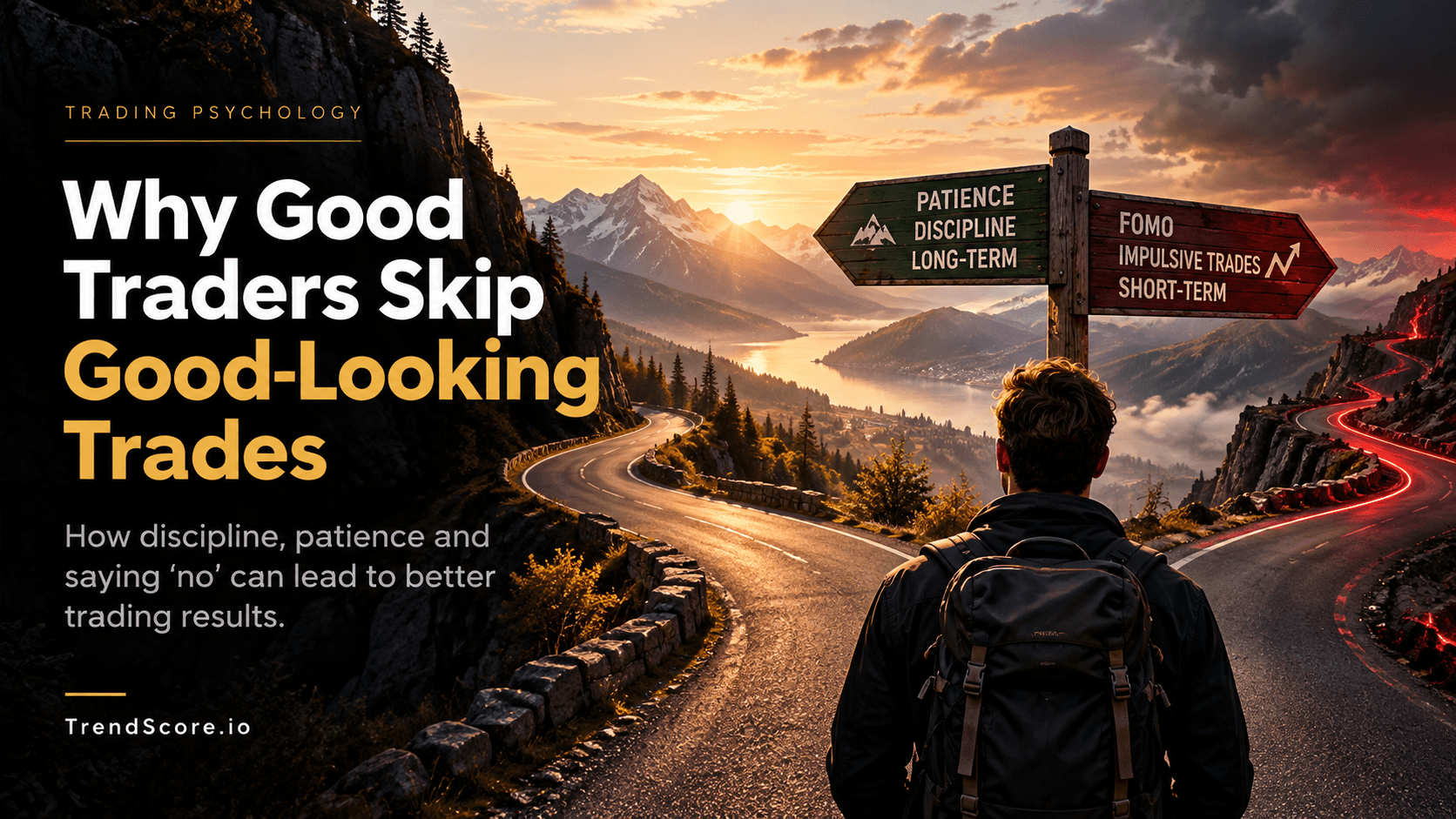
One of the strangest lessons in trading is that improvement often means trading less.
Beginners usually believe experienced traders possess the ability to identify more opportunities.
In reality, experience often creates the opposite behaviour.
Good traders become better at saying no.
No to late entries.
No to weak risk-to-reward.
No to trades taken simply because nothing else is happening.
No to chasing a move that already happened.
And sometimes, no to a setup that actually looks pretty good.
Trading creates pressure to participate
If you sit in front of a market long enough, eventually doing nothing begins to feel uncomfortable.
Prices are constantly moving.
Someone somewhere is making money.
Social media displays screenshots of enormous gains.
A coin you considered buying suddenly moves 15% without you.
All of this creates the impression that inactivity equals missed opportunity.
It doesn't.
Cash is also a position.
Waiting is also a decision.
And avoiding a low-quality trade can contribute just as much to long-term performance as entering a successful one.
FOMO usually changes the economics of the trade
Fear of missing out rarely causes traders to discover opportunities early.
It usually causes them to enter late.
A trader watches an asset rise.
At first, they are uncertain.
The price moves higher.
Confidence increases.
It moves higher again.
Now the trader feels urgency.
By the time the position is opened, the original opportunity may have changed completely.
Potential upside has decreased.
The stop often needs to be wider.
Risk-to-reward becomes worse.
Ironically, the trader feels most confident exactly when the trade has become less attractive.
A setup doesn't owe you a trade
One useful psychological shift is separating analysis from participation.
You can correctly identify a bullish market and still decide not to buy it.
You can identify a likely breakdown and still avoid shorting it.
Analysis answers:
"What is happening?"
Trading asks a different question:
"Does what is happening offer an opportunity worth risking capital on?"
Those questions should never be confused.
Discipline is easier when rules exist before the trade
Telling someone to "be disciplined" is not particularly useful.
Discipline becomes much easier when decisions are structured.
For example:
Only consider trades above a certain quality threshold.
Define the stop before entering.
Require an acceptable risk-to-reward ratio.
Avoid increasing risk after entering.
Do not move a stop simply because the position is losing.
Do not chase a setup once the planned entry zone has disappeared.
Rules remove some of the negotiation traders otherwise have with themselves.
Without rules, every market movement becomes a fresh emotional decision.
Missing trades is part of trading
This is worth repeating because almost every trader struggles with it.
You will miss profitable trades.
Sometimes you will watch exactly the scenario you expected unfold without having a position.
That is not failure.
If the trade did not meet your criteria when the decision needed to be made, avoiding it was still correct.
Trading quality should be judged by the decision using information available at the time—not by looking backward after seeing the result.
A poor decision can make money.
A good decision can lose money.
Over time, the objective is to repeat good decisions.
That distinction is at the heart of disciplined trading.