
Numbers create confidence.
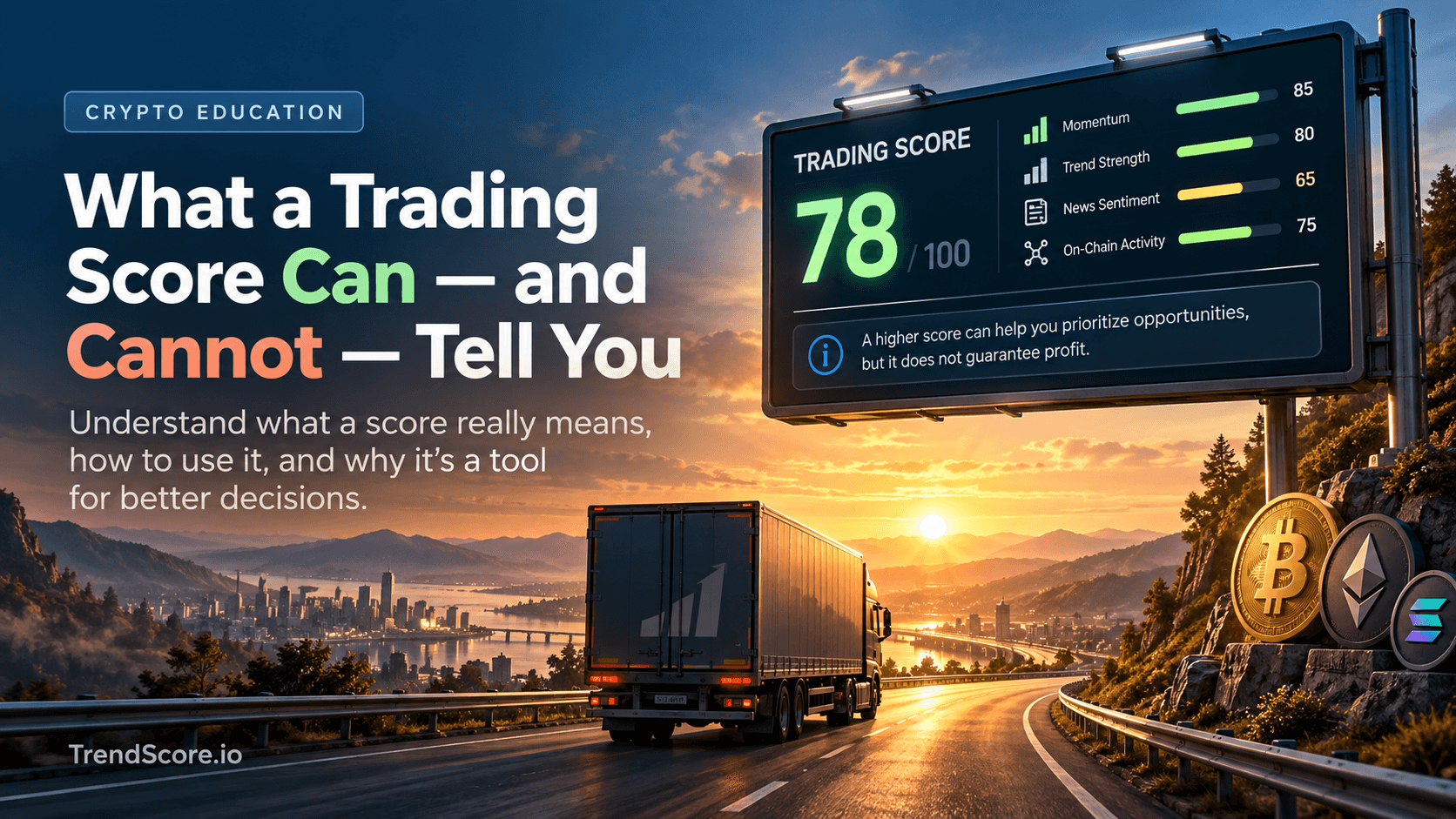
A score of 82 feels more convincing than someone saying "this setup looks pretty strong."
A score of 340 feels even more convincing.
But trading scores are useful only when people understand what they actually represent.
A scoring system should help organize information.
It should never be mistaken for certainty.
Why markets need filtering
Crypto markets contain thousands of assets and an enormous amount of information.
Even if a trader focuses only on actively traded pairs, manually reviewing every chart across multiple timeframes would require enormous amounts of time.
This creates a practical problem.
How do you decide where to look?
One solution is systematic filtering.
Instead of manually opening hundreds of charts, data can be analyzed according to predefined conditions.
Assets meeting more favourable combinations of those conditions can be ranked above assets showing weaker or conflicting characteristics.
The score therefore becomes a prioritization mechanism.
It says:
"This deserves attention."
It does not say:
"This cannot lose."
High probability is not certainty
This distinction is crucial.
Suppose a particular combination of trend, momentum and volatility has historically created favourable trading conditions.
When those conditions appear again, they may increase the attractiveness of the setup.
But every market event still contains uncertainty.
Unexpected news appears.
Liquidity changes.
Bitcoin moves suddenly.
A breakout fails.
Large participants enter or exit positions.
No scoring system removes these variables.
A strong score should therefore increase attention—not eliminate risk management.
Why multiple factors matter
A useful ranking system should avoid depending excessively on one metric.
Consider RSI.
An oversold reading might look attractive.
But what happens if the asset is simultaneously experiencing:
A powerful downtrend?
Rapidly increasing volatility?
Weak market structure?
Heavy selling pressure?
The RSI number hasn't changed.
Its meaning has.
That is why combining multiple independent observations can produce a more complete picture than using one isolated indicator.
The score and the trade are different things
Another important distinction is between setup quality and trade construction.
A market may produce strong analytical conditions but still offer an unattractive entry.
Perhaps price moved too far before the trader noticed.
Perhaps the required stop is too wide.
Perhaps the remaining upside is too small.
This means a high-quality market observation does not automatically mean entering at any price.
Entry, Stop Loss and Take Profit remain essential components of the decision.
What should a trader do with a score?
The healthiest way to interpret a trading score is as the beginning of analysis rather than the end.
A higher-ranked setup deserves closer examination.
Look at the direction.
Study the entry.
Understand the stop.
Review the targets.
Consider current market conditions.
Then decide whether the opportunity fits your own risk framework.
Technology can process enormous amounts of information extremely quickly.
But disciplined trading still requires understanding what that information means.
A score is powerful when it helps traders focus.
It becomes dangerous when it replaces thinking.