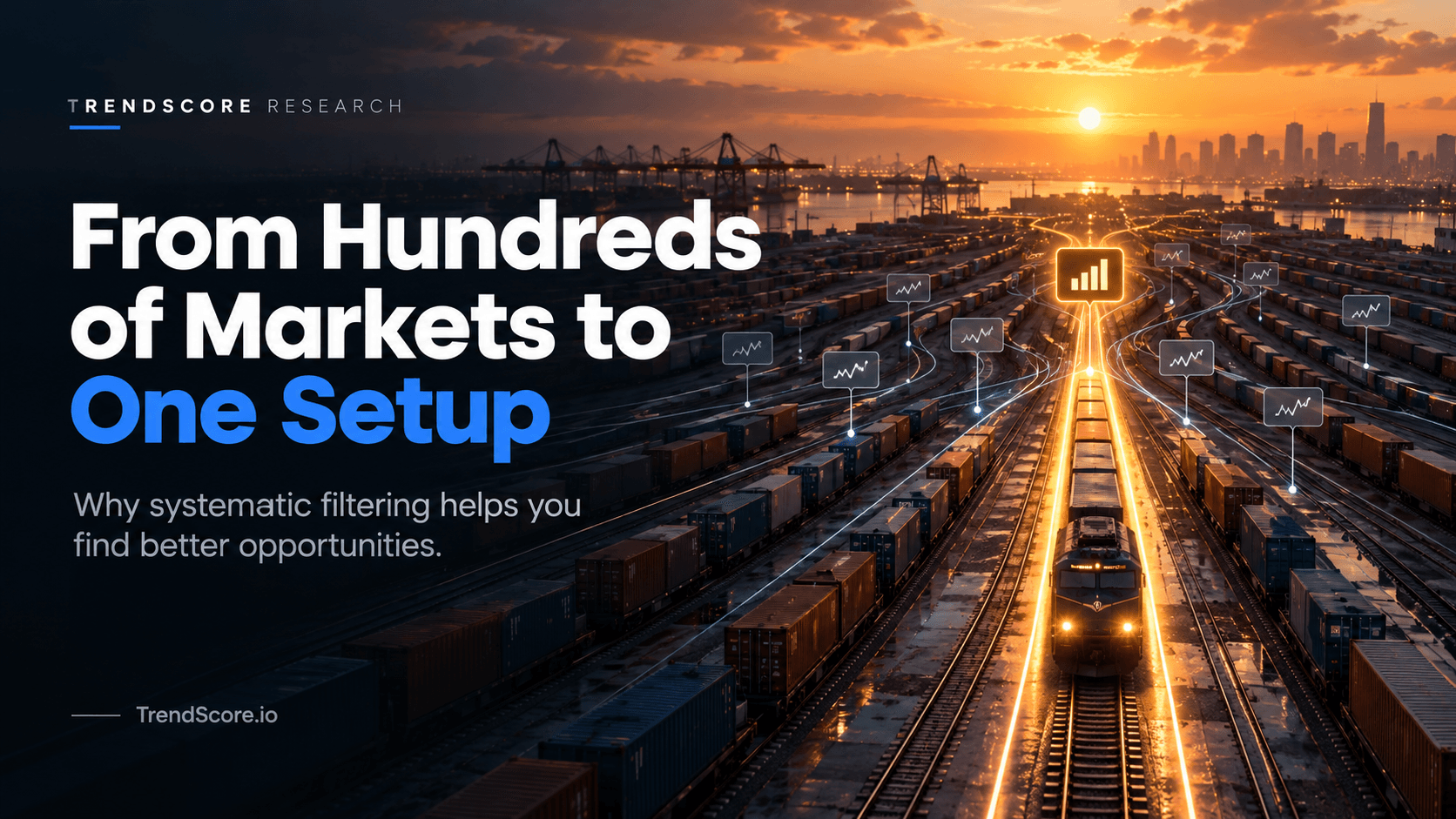
The crypto market has an attention problem.
There are too many assets, too many charts, too many indicators, too many social-media opinions and too many movements happening simultaneously.
Most traders don't suffer from a lack of information.
They suffer from too much of it.
This is exactly why filtering is one of the most underrated parts of market analysis.
The objective isn't to analyze everything manually
Imagine attempting to review hundreds of markets individually.
Open a chart.
Check the trend.
Review momentum.
Measure volatility.
Study the timeframe.
Compare potential reward and risk.
Close it.
Open the next chart.
Even if each review took only one minute, the market could begin changing before the process was completed.
Humans are not particularly good at this kind of repetitive analysis.
Computers are.
That doesn't mean software automatically understands the market better than a human trader.
It means software is extremely good at processing large amounts of structured information consistently.
That difference matters.
Consistency is one of the biggest advantages of systematic analysis
Human analysis changes with mood.
After several winning trades, traders may become more optimistic.
After several losses, the exact same chart can suddenly look threatening.
Fatigue matters.
Bias matters.
Recent experiences matter.
A systematic scanner doesn't become excited because it won yesterday.
It doesn't revenge trade.
It doesn't become bored.
The same conditions are evaluated according to the same framework.
That consistency makes systematic analysis particularly useful during the discovery stage of trading.
Filtering is different from forecasting
At TrendScore, the objective of scanning is not to declare that one particular asset is guaranteed to move.
The objective is to reduce a very large universe of potential markets into a much smaller group showing comparatively stronger conditions.
Think about an airport security process.
Thousands of items may pass through a system.
The purpose of the scanner is not to claim that every flagged object represents a problem.
It is to identify what deserves closer inspection.
Market scanning works in a similar way.
The valuable question becomes:
"Out of everything happening right now, what deserves our attention?"
Ranking creates relative information
This becomes especially powerful when markets are compared with each other.
Suppose 300 assets are analyzed.
Twenty appear moderately attractive.
Five demonstrate stronger alignment across several metrics.
One or two clearly stand out.
Without ranking, the trader simply sees hundreds of charts.
With ranking, attention can be concentrated where the data shows unusual alignment.
This does not remove losing trades.
It removes a great deal of noise.
Risk still comes after selection
A scanner can identify interesting conditions.
That still isn't enough.
A setup should also define how the idea will be traded.
Where is the entry?
Where does the hypothesis become invalid?
Where could profits reasonably be taken?
Does the potential reward justify the risk?
These questions are why TrendScore combines market selection with structured LONG/SHORT scenarios containing predefined Entry, Take Profit and Stop Loss levels.
The purpose isn't simply to say "bullish" or "bearish."
It is to turn analysis into something measurable.
Better trading starts with better selection
Many traders concentrate almost entirely on improving entries.
Sometimes the bigger improvement comes one step earlier.
Trade better markets.
Ignore weaker conditions.
Demand stronger alignment.
Allow the system to say that nothing currently deserves your capital.
The most valuable output of a scanner isn't always the trade it finds.
Sometimes it is everything it helps you avoid.